
Daniel Mirea (16 September, 2026)
| The NeuroAffective-CBT® Journal |
Companion article: This article develops the clinical illustration and conceptual pathway introduced in Beyond ‘Fake It Till You Make It’: The Pendulum-Effect, Embodied Rehearsal and the Development of the Integrated-Self. Whereas the earlier article examined how embodied rehearsal can make an inhibited response increasingly available, the present article explores how values-guided behavioural experiments may support the development of preferences, boundaries, authorship and authentic living.
Abstract
Authenticity is sometimes understood as the expression of a stable inner identity that must be discovered before it can be lived. Conversely, behavioural change may be presented as “acting as if”: imitating confidence or concealing distress until a preferred identity becomes convincing. Both positions are incomplete. The first risks treating familiar protective responses as evidence of an essential self; the second risks encouraging performance, masking and emotional invalidation. This conceptual article proposes that authenticity can be both discovered and developed through values-guided behavioural experiments. It argues that shame-organised protective responses are repeatedly enacted through attention, posture, voice, affect, behaviour and relationship. Within the NeuroAffective-CBT® (NA-CBT) Pendulum-Effect Formulation, overcompensation, avoidance and capitulation are understood as interconnected protective positions organised around a shared affective threat. In the form examined here, that threat is internalised shame. Repeated enactment can make a restricted protective repertoire feel natural, personal and true.
Building upon an earlier NA-CBT account of embodied rehearsal and the development of the Integrated-Self, the present article examines the implications of this process for authenticity. It draws upon Stanislavski’s pursuit of truthful action under imagined circumstances, Vygotsky’s socially situated account of the actor’s emotion, Moreno’s use of role and enactment in psychodrama, contextual accounts of values, and contemporary research on mental imagery. It describes how the therapeutic relationship and everyday life can become contexts in which clients recognise Pendulum movements and test alternatives to proving, hiding or surrendering. Through imagery, embodied rehearsal, graded action, reflection, recovery and repetition, unfamiliar responses may become increasingly available within the Integrated-Self. Repeated values-guided experiments may do more than make an inhibited response behaviourally available: they may help clients differentiate values, discover preferences and boundaries, and recognise authorship of unfamiliar but genuinely chosen actions. Authenticity is therefore conceptualised neither as an unchanging essence waiting to be uncovered nor as a persona installed through performance. It develops through an iterative relationship among felt experience, values, chosen action, relational feedback and autobiographical meaning.
Keywords: authenticity; values; behavioural experiments; embodied rehearsal; mental imagery; shame; Pendulum-Effect Formulation; Integrated-Self; NeuroAffective-CBT®
Introduction: Can Authenticity Develop Through Action?
“Anna” is a fictionalised composite constructed from several clinically similar cases. Identifying details, circumstances and sequences of events have been altered and combined to protect confidentiality. She had long experienced anxiety in social and interpersonal situations, although her difficulties did not fully meet the diagnostic criteria for social anxiety disorder.
When Anna entered therapy, she said that she wanted to become more confident. What she meant was that she wanted anxiety to disappear before she acted. She imagined that confident people spoke because they felt certain, while she remained silent because something essential was missing within her.
Her first behavioural experiment was deliberately modest. She was not asked to dominate a meeting, deliver a flawless presentation or behave as though she felt no anxiety. She prepared one genuine question and agreed to raise it within the first ten minutes.
When Anna imagined herself speaking, her shoulders lifted, her jaw tightened and she felt an urge to delay. She oriented towards the imagined room, felt the support of the chair and allowed a slower exhalation. She then rehearsed the question aloud. At first, her voice was quiet and apologetic, and she surrounded the question with explanations designed to protect her from being wrong. Gradually, she practised saying the same words more simply. She was not pretending to be another person. She was using her own voice to attempt a response that her established protective system rarely permitted.
At the meeting, Anna’s chest tightened and the familiar instruction returned: Wait until you are completely certain. This time, she asked the question. Nobody applauded, and she did not feel suddenly transformed. The question was answered and the meeting continued.
That ordinary continuation mattered. Anna had spoken while activated; her body mobilised and then began to recover. Her prediction of humiliation had not occurred, but neither had she proved that criticism would never happen. She learned something more credible: uncertainty did not make participation impossible. The anxiety was real, the bodily activation was real and the old prediction was still present. The action was also real.
Do not fake the feeling. Practise the action, remain connected to the body, observe what happens and allow the experience to revise what seems possible.
Anna’s first experiment was introduced in an earlier article examining how embodied rehearsal, graded action, reflection and repetition may allow a previously inhibited response to become increasingly available within the Integrated-Self (Mirea, 2026). That article focused principally on the movement from a shame-organised protective pattern towards embodied possibility. Anna discovered that she could participate while anxiety and self-doubt remained present.
Her question at the meeting, however, was not an isolated success or the conclusion of the therapeutic process. It became the beginning of a broader inquiry into how she related to her work, her therapy and herself. If she no longer allowed the need to prove her competence, avoid exposure or surrender to self-attack to organise every decision, what would she genuinely value? What preferences, boundaries and ways of relating might become visible? Could an action that initially felt unfamiliar nevertheless be recognised as authentically her own?
The present article continues Anna’s clinical illustration and develops the implications of this process for authenticity. Its central question is no longer only how a different response becomes possible, but what a person may discover and develop by repeatedly acting in relation to what matters. As Anna experimented with participation, honesty and self-respect across work and therapy, her values became more differentiated, previously obscured preferences and boundaries became increasingly available, and unfamiliar actions could gradually be recognised as her own.
The theoretical progression is therefore from embodied possibility towards values-guided authorship and authentic living. Imagery and rehearsal make a different response conceivable and enactable. Graded behavioural experiments test that response within the therapeutic relationship and everyday life. Reflection helps the person evaluate what the experience reveals about their values, preferences and capacities. Authorship connects the chosen action with a developing autobiographical understanding of self. Authenticity, from this perspective, is neither uncovered as a finished identity nor installed through repeated performance. It is discovered and developed through the continuing relationship among felt experience, values, chosen action, relational feedback and meaning.
People frequently postpone action until an internal state grants permission: When I feel confident, I will speak. When I stop feeling ashamed, I will allow myself to be visible. When I know who I really am, I will begin to live authentically. This expectation appears reasonable, yet it can maintain the very pattern the person hopes to escape. Confidence remains unavailable because participation is repeatedly postponed. Personal preferences remain unclear because approval is continually prioritised. Identity feels fixed because only a narrow protective repertoire is enacted.
The familiar instruction to “fake it till you make it” reverses this sequence by placing action before feeling. Its intuition is clinically useful, but its language is misleading. It suggests that change requires a counterfeit performance: the person should conceal anxiety, imitate a socially valued identity and continue until the performance becomes subjectively convincing. For clients whose difficulties already involve masking, compliance, perfectionistic performance or disconnection from their needs, such an instruction may reproduce the problem rather than resolve it.
A more useful starting point is that the person is already repeatedly enacting a way of being. Internalised shame is not maintained by belief alone. It is enacted through where attention is directed, how the body mobilises or withdraws, which words are spoken or withheld, how relationships are approached, and how the person interprets and treats themselves afterwards. Over time, these responses may become sufficiently familiar to be mistaken for identity.
The distinction between familiarity and authenticity is therefore crucial. A response does not necessarily express an authentic self simply because it feels natural or longstanding. Someone who has spent years accommodating other people may experience a reasonable boundary as artificial. A person organised around perfectionism may experience ordinary participation as careless. Someone accustomed to silence may describe speaking clearly as “not me”. These reactions do not prove that the unfamiliar response is fraudulent. They may show that the existing protective response has been rehearsed for longer.
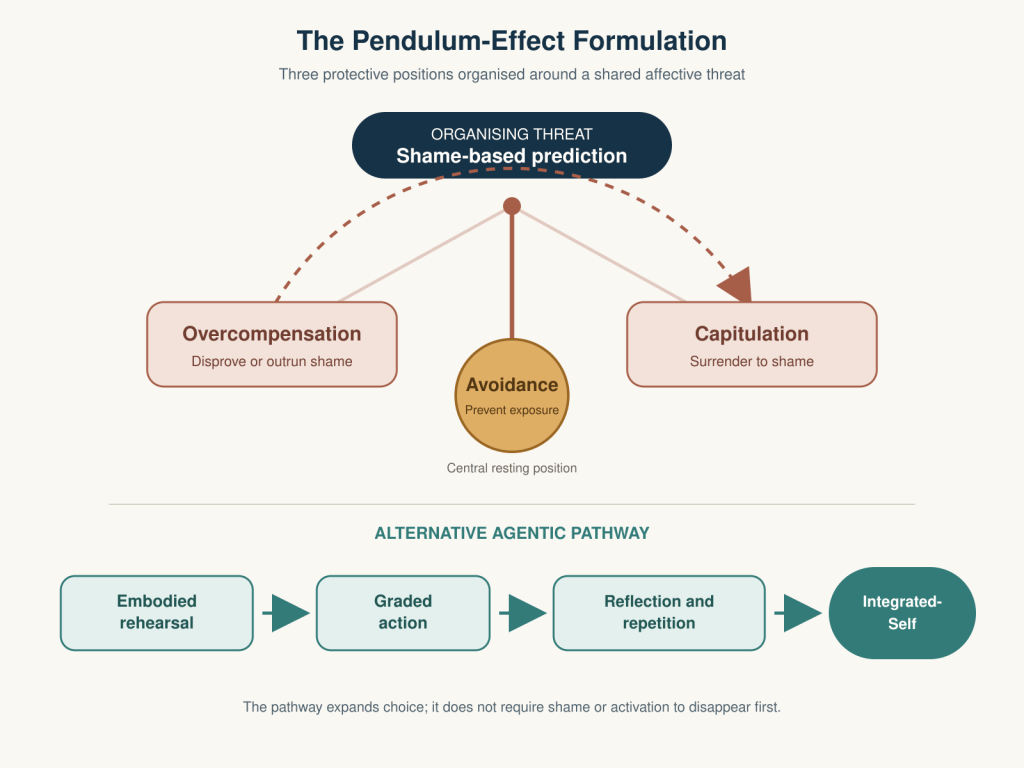
The Pendulum-Effect Formulation identifies protective movement around a shared affective threat. The present article focuses specifically on movements organised around internalised shame, although other affective threats may organise comparable protective patterns. Within a shame-organised pattern, a person may move among three broad protective positions: Overcompensation, through which the shame-based account is disproved by achievement, control, perfectionism or approval; Avoidance, through which anticipated exposure is prevented; and Capitulation, through which the shame-based account is accepted as though it were established fact.
These positions may appear contradictory, but they can belong to the same protective system. The person may overperform until certainty or approval can no longer be secured, withdraw to escape anticipated exposure, and then attack or abandon the self for having withdrawn. Each response protects against or regulates the same affective threat while also restricting the person’s available ways of acting and relating.
If protective Pendulum movements are already being repeatedly enacted, psychotherapy can redirect rather than invent the human capacity for rehearsal. The person can begin to imagine and embody responses organised around emerging values rather than shame. These responses are tested within the therapeutic relationship and everyday life, reflected upon, adapted and repeated. New emotions, preferences, boundaries and forms of relationship may emerge through this process.
The person does not simply behave differently because they have discovered a finished authentic self. Nor do they manufacture an identity by repeatedly performing a preferred character. Instead, they participate in developing a more authentic way of living through what they choose, enact, experience and make meaning of. Authenticity remains responsive to context: a chosen boundary may be authentic, but so may proportionate openness; participation may express a value, but so may deliberate withdrawal from an unsafe situation. Function and authorship matter more than appearance alone.
A behavioural experiment commonly tests a belief or prediction through planned experience rather than discussion alone (Greenberger and Padesky, 2016). A values-guided behavioural experiment is not designed merely to determine whether a feared prediction is accurate. It also explores what becomes possible when a value is permitted to influence action alongside fear, shame or self-doubt.
The person identifies the protective prediction, attempts a specific values-consistent response, observes its bodily, emotional and relational consequences, and reflects upon what the experience reveals about their capacities, preferences and ways of relating. The action may be retained, modified or rejected. The purpose is not to confirm a predetermined ideal but to generate information that could not become fully available while the person remained organised around proving, hiding or surrendering.
In this sense, the experiment tests not only what will happen in the situation, but what the person may become able to recognise, tolerate and choose. Through repetition across different contexts, a response that initially feels unfamiliar may become increasingly available. Through reflection and authorship, the person may also begin to recognise: This was not merely a role I performed. It was something I chose and was capable of doing.
The central proposition of this article is therefore:
Overcompensation, Avoidance and Capitulation repeatedly enact the predictions of internalised shame and can make those predictions feel personal and true.
Values-guided behavioural experiments use imagery, embodied rehearsal, relational testing and everyday action to explore alternative responses without requiring fear, shame or uncertainty to disappear first.
Through reflection, adaptation and repetition, these responses may become increasingly available within the Integrated-Self, while helping the person differentiate values, discover preferences and boundaries, recognise authorship and develop what an authentic life means for them.
Acting Truthfully Under Imagined Circumstances
The apparent contradiction between rehearsal and authenticity has a long history in the theatre. Acting can be treated as imitation: the performer reproduces recognisable external signs of emotion while remaining experientially separate from the role. Yet the tradition associated with Konstantin Stanislavski sought something more demanding than the reproduction of emotional appearance. His system was concerned with truthful, purposeful action within the given circumstances of the drama. The actor knows that the setting is constructed, but does not therefore approach every response as false. Through attention, imagination, objectives, physical action and repeated rehearsal, the performer develops conditions under which the role can be experienced and enacted with psychological credibility (Stanislavski, 2008, 2009).
Stanislavski’s “magic if” is especially relevant. The question is not simply, How would this character look? It is closer to, What would I do if I were living within these circumstances? The “if” creates an imaginative bridge without requiring the actor to confuse theatre with ordinary life. It connects possibility with action. The actor works neither by waiting passively for spontaneous inspiration nor by mechanically displaying an emotional stereotype. Rehearsal creates a structured route through which attention, intention, movement and feeling may become organised around the dramatic situation.
This does not mean that psychotherapy is theatre or that clients should perform invented characters. The parallel is more precise. Both fields challenge the assumption that authenticity must arrive fully formed before disciplined action begins. An actor may approach truthful performance through rehearsal; a client may approach a more authentic life by rehearsing actions that express values and inhibited capacities before those actions feel familiar. Indeed, their initial unfamiliarity does not make them fraudulent; it may simply reflect how much longer the existing protective response has been rehearsed.
At the same time, Stanislavski’s work warns against a shallow understanding of acting as if. The aim is not to paste the outward signs of confidence over an unchanged relationship with shame. In therapeutic rehearsal, the action requires an internal and relational purpose. The client is not instructed to appear assertive, warm or independent. They are invited to explore what they would do if a chosen value—self-respect, honesty, connection, curiosity or courage—were allowed to influence the situation alongside fear.
Emotion, Role and Social Meaning
Lev Vygotsky’s discussion of the psychology of the actor complicates any simple division between genuine and performed emotion. Engaging with Stanislavski’s system and Diderot’s paradox of the actor, Vygotsky asked whether an actor must personally experience the feelings represented on stage or whether those feelings are produced through the organisation of performance. He rejected an account of the actor’s emotion as a purely private or biological event. The experience is shaped by role, dramatic action, historical tradition, social meaning and the relationship with an audience (Vygotsky, 1999; original work published 1932).
Vygotsky did not provide a modern psychotherapy protocol for values or embodied rehearsal. His relevance lies elsewhere. He placed emotion within a culturally and socially organised activity. The actor’s feeling cannot be understood simply by isolating an internal state from the role being enacted and the meanings surrounding it. This position helps resist two opposite errors in psychotherapy. The first is to treat an emotion as an unmediated revelation of identity: I feel inadequate, therefore inadequacy is who I am. The second is to treat emotion as irrelevant so long as an acceptable behaviour can be performed. In both acting and therapy, the relationship among feeling, action, meaning and context matters.
Values also acquire substance within social and practical life. They are shaped and negotiated within family, cultural, relational and material contexts rather than chosen by an isolated individual. Honesty, care, creativity or self-respect are not merely words selected from a list. They become meaningful through situated choices: what the person says when disagreement risks rejection; whether care includes boundaries; whether belonging requires self-erasure; and whether fear is permitted to coexist with participation. A value is not demonstrated by verbal endorsement alone. It becomes visible in patterns of action and relationship.
From this perspective, acting as if does not ask the client to experience a prescribed emotion. It asks whether a different action can be organised within the current emotional and relational conditions. The client may still feel fear, shame or doubt. The question is whether those experiences must control the entire response.
Role, Enactment and Surplus Reality
J. L. Moreno carried action and role directly into psychotherapy. In psychodrama, clients do not only describe conflicts, memories and relationships. They enter a structured dramatic space in which these experiences and possible responses can be enacted. Role reversal, doubling, mirroring and role training allow different perspectives and behavioural positions to be attempted, witnessed and reflected upon (Moreno, 1946; Cruz et al., 2018).
Moreno’s role theory is particularly relevant to authenticity. He proposed that the self emerges through the roles a person develops and performs, describing role as a bridge between psychiatry, psychology and sociology (Moreno, 1946, 1961). Development, from this perspective, need not mean excavating one fixed identity concealed beneath behaviour. It may involve expanding the role repertoire and increasing spontaneity: the capacity to produce a sufficiently new response to an old situation, or an adequate response to a new one (Moreno, 1947, 1955).
This expansion does not require a person to become somebody else. A new role may offer temporary access to an inhibited capacity. Someone organised around compliance may rehearse disagreement. Someone governed by shame may practise being visible without performing perfection. Someone who anticipates helplessness may speak from a position of agency. Initially, the words can feel borrowed or artificial. Nevertheless, it is the client’s body producing the voice, tolerating the visibility and remaining in relationship.
Moreno’s concept of surplus reality extends this possibility. The psychodramatic space permits enactment of what did not happen, has not yet happened or could not safely be expressed in everyday life (Moreno, 1965). A boundary may finally be spoken; an unacknowledged need may be voiced; a future encounter may be rehearsed. The enactment is not equivalent to lived reality, but it can provide an experiential bridge between what the person currently predicts and what they may gradually become able to tolerate and perform.
The fictional or protected frame may also reduce immediate self-surveillance. A client can first try a sentence “in role”, or speak from a chair representing a possible future position. Yet therapeutic consolidation eventually asks: What did you do—not merely what did the role do? The purpose is not to credit a temporary character with the action, but to help the person recognise authorship of a capacity that was previously excluded from their self-understanding.
Contemporary drama-based interventions employ related processes, including role, narrative, enactment, distancing and witnessed performance. Reviews report promising findings while also identifying substantial variation in populations, interventions, methods and study quality (Berghs et al., 2022; Jiang et al., 2023). These findings justify careful clinical exploration; they do not establish that enactment reliably installs safety, authenticity or a new identity.
Mental Imagery in Values-Guided Experiments
Imagery adds an important psychological bridge between verbal intention and lived enactment. Mental imagery can evoke emotion more strongly than purely verbal representation and can simulate perceptual and experiential aspects of events (Holmes and Mathews, 2010; Ji et al., 2016). Prospective imagery can also influence anticipation, motivation and behavioural engagement, although effects depend upon the task, population and way imagery is used (Ji, Geiles and Saulsman, 2021; Cole et al., 2021).
This makes imagery clinically powerful but not inherently therapeutic. A shame-organised future image may function as a rehearsal of failure: the person sees faces turning towards them, hears their own voice falter, anticipates contempt and experiences bodily mobilisation before entering the room. Repetition may increase the subjective availability of the feared sequence. The image is treated as foresight rather than as a prediction shaped by prior learning.
Therapeutic imagery does not merely replace this scene with effortless success. An idealised image in which anxiety disappears and everyone responds warmly may be emotionally appealing but provide little preparation for the actual task. A more useful exercise activates the anticipated situation within tolerable limits and introduces a values-consistent response while preserving uncertainty.
The client might imagine entering a meeting and noticing the first signs of bodily bracing. They identify the urge to overexplain, remain silent or agree automatically. The image is slowed sufficiently to make choice possible. They then rehearse a concise contribution, feel their feet on the floor, direct attention towards the conversation and imagine remaining present while uncertainty continues. The sequence includes not only the desired action but recovery: how the person breathes after speaking, tolerates an ambiguous expression, responds to disagreement and prevents the event from becoming fuel for later self-attack.
Imagery therefore contributes at least four functions:
- It makes the shame-based prediction observable rather than unquestioned.
- It evokes sufficient affective and bodily involvement for rehearsal to be meaningful
- It permits alternative actions and responses to difficulty to be explored before real-world testing.
- It helps translate an abstract value into a situated pattern of attention, voice, movement and relationship.
The aim is not to imagine a completed ideal identity and perform it into existence. It is to create a provisional model of possible action, embody it sufficiently to increase the likelihood that it cn be accessed, test it, and revise it in response to experience.
The Pendulum-Effect Formulation: How Shame Narrows What Feels Possible
The Pendulum-Effect Formulation identifies a recurring movement among overcompensation, avoidance and capitulation around a shared affective threat. Shame is especially important because it readily becomes an account of the whole self. The person moves from:
‘I feel exposed’ to ‘I am inadequate’
‘I made a mistake’ to ‘I am a failure’
‘This relationship feels uncertain’ to ‘I am unlovable’
Overcompensation attempts to disprove that conclusion. The person works excessively, controls detail, becomes indispensable, seeks reassurance, performs confidence or monitors other people for evidence of approval. Avoidance prevents the anticipated exposure by withholding opinions, declining contact, delaying action, concealing need or leaving situations. Capitulation accepts the shame-based conclusion through helplessness, self-attack, submissiveness or withdrawal from valued activity.
These positions are repeatedly embodied. Overcompensation may appear as urgency, muscular tension, restricted breathing, relentless speech and vigilant attention to other people’s reactions. Avoidance may involve constricted movement, reduced voice, averted gaze and narrowed participation. Capitulation may be accompanied by heaviness, reduced agency and repetitive self-condemning language. The body does not merely display a belief that has already been formed elsewhere. Bodily state, attention, prediction, affect, behaviour and relationship participate in the experience from which the shame-based identity feels true (Barsalou, 2008; Niedenthal, 2007).
The Pendulum is also relationally self-reinforcing. A person who overfunctions may attract dependence while remaining unknown. Someone who conceals disagreement may experience relationships as superficially peaceful but internally unsafe. A person who withdraws before others can respond receives little information about whether contact, difference or repair were possible. Capitulation then interprets the resulting loneliness, exhaustion or resentment as evidence of defectiveness.
The issue is therefore not simply that the person possesses an inaccurate core belief. They repeatedly encounter themselves while proving, hiding or surrendering. These enacted experiences become autobiographical evidence for the identity they were originally designed to protect against.
The Pendulum positions can be summarised through three shame-organised instructions:
- Overcompensation: I must prove my worth.
- Avoidance: My presence, needs or imperfection must remain hidden.
- Capitulation: The shame-based account of me is true, and I have no effective choice.
Therapeutic change does not add a fourth Pendulum position. It develops a more flexible alternative to automatic Pendulum control:
I can remain present, relate honestly and act according to what matters without having to prove, hide or abandon myself.
The Therapeutic Relationship as the First Site of Experimentation
The therapy room is not merely a protected place in which the client prepares for relationships elsewhere. It is itself a real relationship in which the Pendulum may become visible.
A client moving towards overcompensation may try to become the ideal client: completing every task perfectly, intellectualising their experience, presenting sophisticated explanations or assuring the therapist that treatment is working. Another may monitor the therapist’s face and rapidly revise what they say. Avoidance may appear through silence, changing the subject, minimising need, withholding disagreement, arriving late or becoming emotionally absent. Capitulation may involve automatic agreement, treating the therapist as unquestionably right, relinquishing agency or interpreting therapeutic difficulty as proof of being beyond help.
These responses should not be confronted as resistance or dishonesty. They can be recognised as relationally intelligent adaptations with histories and protective purposes. The therapeutic question becomes: What does this movement anticipate, prevent, disprove or make certain between us?
Once recognised, the relationship offers an immediate opportunity for a different response. The client may rehearse telling the therapist that a formulation does not fit, that an intervention felt unhelpful, that they are disappointed, or that they need more time. They may allow a silence without filling it through performance. They may receive care without becoming compliant, or express a boundary without withdrawing from the relationship.
Authenticity here does not mean unrestricted disclosure or saying everything one feels. It means that the client can increasingly remain in contact with experience, values and agency while responding to the actual relationship. A boundary can be authentic; so can chosen privacy. Connection can be authentic; so can proportionate distance. The relevant distinction is not between participation and withdrawal in themselves, but between chosen action and action automatically organised by shame.
This therapeutic enactment provides several forms of learning. The client discovers that difference need not automatically destroy connection, that embarrassment can be survived, that misunderstanding may be repaired and that a relationship can contain two perspectives. Equally, the therapist’s response may reveal that the client’s concern is valid. The aim is not to force every experiment into a reassuring conclusion. Authenticity requires contact with reality, including disappointment, limitation and the need for protection.
Values as Directions That Become Known Through Living
Values provide an organising alternative to the Pendulum, but they should not become another perfectionistic standard. Within contextual behavioural traditions, values are commonly understood as chosen qualities or directions of action rather than outcomes that can be permanently completed (Hayes, Strosahl and Wilson, 2012). In the present formulation, values help answer a specific question: If shame did not make the entire decision, what way of relating would matter here?
The answer may involve honesty, connection, curiosity, courage, care, creativity, self-respect or justice. Yet values are not always fully accessible before action. A person whose preferences have been organised around approval may genuinely not know what they like. Someone who has survived through compliance may struggle to distinguish care from self-erasure. Values clarification therefore cannot be confined to selecting admirable words.
Values become differentiated through lived experiments. The person notices which actions produce vitality, integrity, grief, relief, resentment or connection. They discover that a presumed value was inherited from a family or social role, while an overlooked interest becomes personally meaningful. New likes and dislikes emerge. Boundaries become more specific. The person learns not only what they wish to approach but what they no longer consent to organise their life around.
This is why authenticity is both discovered and developed. It is discovered because the person attends more carefully to felt experience, history, need and desire. It is developed because preferences and capacities change through action, relationship and reflection. The emerging self is neither arbitrary nor predetermined.
Values-consistent action is not always the outward opposite of the Pendulum behaviour. Leaving a dangerous relationship may resemble avoidance while expressing self-protection. Working intensely on a meaningful task may resemble overcompensation while expressing creativity or commitment. Yielding in an unimportant disagreement may resemble capitulation while reflecting generosity or proportion. Function, context and choice matter more than appearance.
The relevant alternative is therefore not necessarily the visible opposite of the existing behaviour, but action that differs from the function of the shame-based strategy. The person does not automatically obey the command to prove, hide or surrender. They choose a response proportionate to present reality and connected to what matters.
A Clinical Illustration: From Protective Performance to Values-Guided Participation
“Anna” is a fictionalised composite constructed from several clinically similar cases. Identifying details, circumstances and sequences of events have been altered and combined to protect confidentiality. She had long experienced anxiety in social and interpersonal situations, although her difficulties did not fully meet the diagnostic criteria for social anxiety disorder. Her question at the meeting was not an isolated success. It marked the beginning of a broader inquiry into how she related to her work, her therapy and herself.
In anticipation of shame, Anna moved towards overcompensation. She prepared excessively, mentally rehearsed every sentence and attempted to eliminate the possibility of error. She volunteered for additional work so that her value would be unquestionable and monitored other people’s expressions for evidence that she had performed well. When certainty or approval could not be secured, she moved towards avoidance: delaying a contribution, weakening what she wanted to say or remaining silent. Afterwards she capitulated, attacking herself and treating her silence or imperfection as proof that she was weak and incapable.
These apparently contradictory responses belonged to the same protective system. Overcompensation attempted to disprove the shame-based account; avoidance prevented its anticipated exposure; capitulation surrendered to it as though it were established fact. Anna also recognised their bodily organisation: urgency, muscular tension and rapid internal rehearsal while proving; constriction and reduced voice while hiding; heaviness and diminished agency while surrendering.
The pattern entered therapy. Anna prepared detailed accounts, searched for the “right” insight and worried about disappointing the therapist. When an interpretation did not fit, she often nodded rather than disagreeing. Therapy could therefore become another place in which she performed competence while remaining partly unknown.
Anna began with two provisional values: honesty and participation. They were provisional because she did not yet know precisely what they would require or what further preferences they might reveal. A recurring therapeutic question was:
If shame and self-doubt did not have the final say, how would I want to relate in this moment?
In imagery, Anna pictured telling the therapist that a recent exercise had felt too structured. Her first imagined sequence ended with the therapist becoming defensive and Anna apologising. The scene was slowed. She noticed the urge to protect the therapist, allowed a longer exhalation and rehearsed one sentence: “I understood the purpose, but I felt less connected to you while we were doing it.” She imagined curiosity, misunderstanding and partial disagreement, and practised remaining present rather than overexplaining, withdrawing or conceding that her experience was wrong.
Anna then said the sentence in the session. The therapist acknowledged the disconnection and invited further discussion. More important than reassurance was Anna’s discovery that she could express a difference, remain physiologically activated and continue relating. She had not performed confidence. She had enacted honesty while uncertain, and the therapeutic relationship had become a real site of rehearsal and revision.
Her subsequent daily experiments developed from the first meeting question. In a later discussion, she expressed a preference about the direction of a project without assembling an exhaustive defence. On another occasion, she declined an additional task rather than using indispensability to secure her position. Neither action felt natural at first. Both were consistent with participation that did not require self-abandonment.
The results were mixed. One colleague welcomed her view; another disagreed. Her boundary was accepted, although she spent part of the evening wanting to reverse it. Reflection focused not only on whether other people approved but on what Anna noticed about herself. She felt interested when collaboration allowed ideas to be developed openly, depleted by status-driven competition and resentful when care became compulsory availability. These reactions were not treated as unquestionable instructions, but as information that chronic approval-seeking had previously obscured.
Across subsequent experiments, Anna’s values became more specific. “Honesty” came to include not pretending agreement. “Participation” meant contributing without performing perfection and allowing others to carry responsibility. Self-respect came to include recoverable limits. She discovered satisfaction in mentoring less experienced colleagues and less interest than she had assumed in advancement organised around visibility and competition. New likes, dislikes, emotions and boundaries did not appear because a finished authentic self had finally been uncovered. They emerged as Anna created enough behavioural and relational space to encounter them.
Anna continued to move towards all three Pendulum positions. Integration did not mean their disappearance, nor did a functionally alternative response require her to occupy the other extreme. She was not asked to replace silence with dominance, compliance with reflexive disagreement or overwork with disengagement. The developing alternative was flexible participation: neither proving, hiding nor surrendering.
Her emerging self-understanding was not, I am finally confident and authentic. It was more credible:
I can notice the urge to prove, hide or surrender and still choose how I want to participate.
A Values-Guided Cycle of Behavioural Experimentation
The therapeutic process is better understood as an iterative cycle than as a fixed sequence applied identically to every client. It begins by recognising a movement towards overcompensation, avoidance or capitulation and identifying the affective threat, prediction, bodily organisation, attentional pattern and relational function involved. The therapist and client then clarify an emerging value without converting it into an idealised identity: I want to relate with honesty is more workable than I must become a completely authentic person.
Present-tense, multisensory imagery can bring the anticipated situation and its difficulties into tolerable contact. The image includes the Pendulum impulse, the values-consistent response, uncertain outcomes and the possibility of recovery rather than scripting compulsory success. The value is translated into one observable response—a sentence, boundary, request, pause or form of participation—and rehearsed through voice, posture, movement and attention. Regulation supports sufficient capacity for learning; it does not require complete calm.
Where relevant, the response can first be enacted within the therapeutic relationship through honesty, disagreement, need, boundary or repair. Because the relationship has real consequences, this encounter cannot be reduced to role-play. The response is then tested in a graded situation in everyday life: one that matters enough to activate the established prediction while remaining sufficiently manageable for observation and recovery.
Reflection compares what was predicted with what occurred, while also attending to bodily recovery, relational consequences, emerging preferences and unexpected meanings. Elements of the response can be retained, modified or rejected. Repetition across settings may increase the capacity’s availability, provided that experimentation remains responsive rather than becoming another rigid rule.
The cycle culminates provisionally in authorship. Here, authorship means recognising a response as something the person has chosen, enacted and incorporated into an evolving understanding of themselves, rather than merely something performed in response to therapeutic instruction or external expectation. The action is connected to a credible account of self: A part of me anticipated shame, and I was also capable of acting according to what mattered. The person owns the action without treating it as evidence of permanent transformation or a completed identity. That authorship then informs the next experiment rather than completing the process.
Authenticity and the Development of the Integrated-Self
Authenticity is sometimes imagined as perfect correspondence between inner feeling and outward behaviour. Such a definition is neither clinically realistic nor ethically sufficient. People contain competing wishes, affects and obligations. Privacy is not necessarily falseness; restraint is not necessarily capitulation; adaptation is not necessarily masking. Authenticity requires context and proportion.
Within this article, an authentic life refers to an increasingly coherent relationship among experience, values and chosen action. The person can recognise fear without allowing fear to impersonate identity, acknowledge shame without accepting its global verdict, and respond to relationship without automatically proving, hiding or surrendering.
Authenticity and integration are therefore related but not identical. Authenticity concerns how experience, values and chosen action are brought into relationship in a particular life. Integration concerns the breadth, connection and flexible availability of the person’s repertoire.
The Integrated-Self refers to the wider and more connected repertoire that develops through this process. Different affects, needs, roles, values and action tendencies can be acknowledged without one protective position controlling the whole response. Integration does not replace the Pendulum with a permanently confident character. It expands what the person can recognise, tolerate, choose and enact.
The person’s identity is therefore not treated as a statement to be installed through repetition. Rehearsal provides experiences; experience generates affective, relational and practical information; reflection organises meaning; and meaning influences subsequent imagination and action. Development remains recursive. What is imagined is tested against reality, and reality revises what is imagined.
This account also leaves room for surprise. A person may discover that a long-pursued goal belonged largely to overcompensation. They may experience anger where compliance previously obscured it, grief when avoidance recedes, or pleasure in an activity they had dismissed. A more authentic life is not simply a calmer version of the old one. It may involve new relationships, interests, boundaries and values.
The phrase reinventing oneself is useful if it does not imply discarding history or manufacturing an ideal persona. Reinvention can mean reorganising the relationship with what has been inherited: preserving capacities that remain valuable, relinquishing responses that have become restrictive and developing possibilities that earlier environments did not permit.
When Values-Guided Experiments Become Another Performance
Embodied rehearsal is not inherently liberating. It can reproduce the Pendulum when it is used to demand acceptable performance.
Rehearsal can become masking when the person is encouraged to conceal distress, fatigue, disability or neurodivergent difference in order to satisfy social expectations.
Values can become overcompensation when they are converted into moral standards the person must perform perfectly. Courage does not require maximal exposure; compassion does not require self-erasure; authenticity does not require indiscriminate disclosure.
Imagery can become coercive when the therapist supplies an ideal future that reflects therapeutic preference rather than the client’s emerging direction.
Functionally alternative action can become flooding when the person is pushed into overwhelming exposure without sufficient consent, preparation or capacity for recovery.
Relational rehearsal can become compliance when the therapist interprets agreement, emotional expression or apparent closeness as evidence of progress while overlooking the client’s fear of displeasing them.
Trauma survivors may already have extensive experience of performing compliance while internally mobilised, frozen or dissociated. Inviting further enactment without attending to power, consent and bodily cues risks repeating the very pattern therapy intends to change. Regulation and relational safety are not optional preliminaries to “real” action; they are part of the conditions under which action can remain chosen and learnable.
Scientific and Conceptual Limits
This article offers a conceptual formulation rather than evidence for a uniquely validated NA-CBT mechanism. Grounded cognition, mental imagery research, psychodrama and behavioural experimentation provide relevant but distinct bodies of knowledge. Their conceptual convergence does not prove that a particular sequence produces an Integrated-Self.
Performed, imagined and lived experiences may overlap in perceptual, motor and affective processes, but they are not interchangeable. Context, consequence, relationship, agency and autobiographical meaning affect what is learned. A successful rehearsal in therapy may not generalise; a values-consistent action may receive a painful response; repetition may consolidate rigidity if it occurs without reflection and adaptation.
Likewise, neuroplasticity is a general property of the nervous system, not evidence that every imagined or repeated action produces therapeutic change. Claims concerning neurological encoding, simulation or reconsolidation require specification of the process measured, the population studied, the conditions and the durability of any effect.
The Pendulum-Effect Formulation also requires empirical development. Its value in the present article is heuristic: it organises observable movement among three protective positions and supports collaborative selection of an alternative response. Future research should examine the formulation’s reliability, clinical utility and incremental contribution beyond established CBT, contextual behavioural and experiential approaches.
Conclusion
Authenticity need not be fully known before values-consistent action begins. Equally, it cannot be manufactured by counterfeiting confidence or performing an ideal identity. The person is not asked to suppress shame or behave as though vulnerability has disappeared. They are invited to recognise how shame may already be organising a restricted and repeatedly enacted repertoire.
Overcompensation rehearses the need to prove worth. Avoidance rehearses the danger of being seen. Capitulation rehearses the apparent truth of the shame-based account. Because these strategies are enacted cognitively, bodily and relationally, their familiarity may be mistaken for authenticity.
Values-guided behavioural experiments can redirect this capacity for repeated enactment. Imagery makes a different response conceivable. Embodied rehearsal gives it voice, posture, movement and affective relevance. The therapeutic relationship allows it to be attempted with another person, while graded action in everyday life tests it beyond the therapy room. Reflection, recovery and repetition help the person evaluate what occurred, recognise authorship and relate the experience to a developing autobiographical understanding.
Through this process, the person may discover preferences, boundaries, relationships and values that could not be fully known while life was organised around proving, hiding or surrendering. Authenticity is therefore neither simply found before action nor installed through performance. It is discovered and developed as imagined possibilities are embodied, lived, evaluated and revised. The Integrated-Self does not denote a permanently confident or completed identity. It describes an increasingly connected and flexible repertoire in which affects, needs, values and action tendencies can be acknowledged without one protective position automatically controlling the whole response.
The central therapeutic question is therefore not, How can I convincingly pretend to be someone else? It is:
If shame did not have the final say, what way of living would I be willing to imagine, test and gradually make my own?
References
Barsalou, L.W. (2008) ‘Grounded cognition’, Annual Review of Psychology, 59, pp. 617–645. https://doi.org/10.1146/annurev.psych.59.103006.093639
Berghs, M., Prick, A.J.C., Vissers, C. and van Hooren, S. (2022) ‘Drama therapy for children and adolescents with psychosocial problems: a systematic review on effects, means, therapeutic attitude, and supposed mechanisms of change’, Children, 9(9), 1358. https://doi.org/10.3390/children9091358
Cole, S.N., Smith, D.M., Ragan, K., Suurmond, R. and Armitage, C.J. (2021) ‘Synthesizing the effects of mental simulation on behavior change: systematic review and multilevel meta-analysis’, Psychonomic Bulletin & Review, 28(5), pp. 1514–1537. https://doi.org/10.3758/s13423-021-01880-6
Cruz, A., Sales, C.M.D., Alves, P. and Moita, G. (2018) ‘The core techniques of Morenian psychodrama: a systematic review of the literature’, Frontiers in Psychology, 9, 1263. https://doi.org/10.3389/fpsyg.2018.01263
Greenberger, D. and Padesky, C.A. (2016) Mind Over Mood: Change How You Feel by Changing the Way You Think. 2nd edn. New York: Guilford Press.
Hayes, S.C., Strosahl, K.D. and Wilson, K.G. (2012) Acceptance and Commitment Therapy: The Process and Practice of Mindful Change. 2nd edn. New York: Guilford Press.
Holmes, E.A. and Mathews, A. (2010) ‘Mental imagery in emotion and emotional disorders’, Clinical Psychology Review, 30(3), pp. 349–362. https://doi.org/10.1016/j.cpr.2010.01.001
Ji, J.L., Burnett Heyes, S., MacLeod, C. and Holmes, E.A. (2016) ‘Emotional mental imagery as simulation of reality: fear and beyond—a tribute to Peter Lang’, Behavior Therapy, 47(5), pp. 702–719. https://doi.org/10.1016/j.beth.2015.11.004
Ji, J.L., Geiles, D. and Saulsman, L.M. (2021) ‘Mental imagery-based episodic simulation amplifies motivation and behavioural engagement in planned reward activities’, Behaviour Research and Therapy, 145, 103947. https://doi.org/10.1016/j.brat.2021.103947
Jiang, L., Alizadeh, F. and Cui, W. (2023) ‘Effectiveness of drama-based intervention in improving mental health and well-being: a systematic review and meta-analysis during the COVID-19 pandemic and post-pandemic period’, Healthcare, 11(6), 839. https://doi.org/10.3390/healthcare11060839
Mirea, D. (2026) ‘Beyond “Fake It Till You Make It”: The Pendulum-Effect, Embodied Rehearsal and the Development of the Integrated-Self’, The NeuroAffective-CBT® Journal, 3 September. Available at: https://neuroaffectivecbt.com/2026/09/03/beyond-fake-it-till-you-make-it-the-pendulum-effect-embodied-rehearsal-and-the-development-of-the-integrated-self/ (Accessed: 12 September 2026).
Moreno, J.L. (1946) Psychodrama: First Volume. Beacon, NY: Beacon House.
Moreno, J.L. (1947) The Theatre of Spontaneity. Beacon, NY: Beacon House.
Moreno, J.L. (1955) ‘Theory of spontaneity-creativity’, Sociometry, 18(4), pp. 105–118. https://doi.org/10.2307/2785848
Moreno, J.L. (1961) ‘The role concept: a bridge between psychiatry and sociology’, American Journal of Psychiatry, 118(6), pp. 518–523.
Moreno, J.L. (1965) ‘Therapeutic vehicles and the concept of surplus reality’, Group Psychotherapy, 18, pp. 211–216. https://doi.org/10.12926/ek7xhv15
Niedenthal, P.M. (2007) ‘Embodying emotion’, Science, 316(5827), pp. 1002–1005. https://doi.org/10.1126/science.1136930
Stanislavski, K. (2008) An Actor’s Work: A Student’s Diary. Translated and edited by J. Benedetti. London: Routledge.
Stanislavski, K. (2009) An Actor’s Work on a Role. Translated and edited by J. Benedetti. London: Routledge.
Vygotsky, L.S. (1999) ‘On the problem of the psychology of the actor’s creative work’, in Rieber, R.W. (ed.) The Collected Works of L. S. Vygotsky, Volume 6: Scientific Legacy. New York: Kluwer Academic/Plenum, pp. 237–244. (Original work published 1932.)
Confidentiality and composite-case statement
“Anna” is a fictionalised composite constructed from several clinically similar cases and is not a single client presented under a pseudonym. Identifying details, circumstances and sequences of events have been altered and combined to protect confidentiality. The illustration does not represent the complete treatment history of any individual client.
Copyright
© 2026 Daniel Mirea. All rights reserved.