

Daniel Mirea (September, 2026)
| The NeuroAffective-CBT® Journal |
Central proposition: We do not always need to feel confident before acting courageously. Carefully graded action can provide an embodied rehearsal through which affect tolerance, agency and self-trust may gradually develop.
She Knew What She Wanted to Say
Anna had prepared for the meeting more thoroughly than anyone else in the room.
She had read the papers twice, highlighted the relevant figures and anticipated several questions her colleagues might ask. The night before, she had rehearsed different versions of what she wanted to say. By the time the meeting began, there was little about the subject that she did not understand.
Yet when the opportunity to contribute arrived, Anna remained silent.
She felt the change in her body before she could put it into words. Her chest tightened, her throat seemed to narrow and her shoulders became rigid. While another colleague was speaking, Anna stopped listening fully and began monitoring herself.
When should I come in? What if I misunderstand the question? What if they realise that I am not as capable as they think?
She waited for the moment when she would feel certain enough to speak. It did not come.
When a colleague made a point similar to the one Anna had prepared, she nodded in agreement and told herself that there was no longer any reason to contribute. For a few seconds, she felt relieved. The danger of being exposed had passed.
The relief did not last. After the meeting, Anna replayed the conversation, criticised herself for remaining silent and treated the incident as evidence about her identity. She was no longer thinking, I found it difficult to speak in that meeting. She was thinking, I am weak. I am inadequate. This is who I am.
Her response was to prepare even more intensely for the next meeting.
Anna’s colleagues would probably have described her as conscientious, capable and exceptionally well prepared. They would not have seen the cycle beneath her competence: the attempt to overcome self-doubt through perfectionism, the withdrawal when certainty remained impossible and the self-attack that followed.
These responses were understandable in the context of Anna’s history. She had learned early that approval followed achievement and that mistakes attracted criticism. Careful preparation had helped her succeed; monitoring other people had helped her detect changes in mood; silence had sometimes protected her from humiliation. The difficulty was that these strategies had become so thoroughly rehearsed that they felt less like strategies and more like aspects of her personality.
When Anna entered therapy, she said that she wanted to become more confident. What she meant was that she wanted the anxiety to disappear before she acted. She imagined that confident people spoke because they felt certain, while she remained silent because something essential was missing within her.
Her first therapeutic experiment was deliberately modest. She was not asked to dominate a meeting, deliver a flawless presentation or behave as though she felt no anxiety. She was asked to prepare one genuine question and raise it within the first ten minutes.
Before rehearsing the question, Anna noticed what happened when she imagined herself speaking: her shoulders lifted, her jaw tightened and she felt an urge to delay. Rather than treating these reactions as proof that she should remain silent, she practised orienting towards the room, feeling the support of the chair and allowing a slower exhalation.
She then rehearsed the question aloud. At first, her voice was quiet and apologetic, and she prefaced the question with several explanations designed to protect her from being wrong. Gradually, she experimented with saying the same words more simply. She was not pretending to be another person. She was using her own voice to practise a response that her established protective system rarely permitted.
At the next meeting, Anna’s chest tightened again. The familiar prediction returned: Wait until you are completely certain.
This time, she asked the question.
She did not experience a sudden transformation. She did not feel fearless and nobody applauded. The question was answered and the meeting continued.
That ordinary continuation mattered. Anna had spoken while feeling activated. Nobody responded with contempt. Her body mobilised and then began to recover. Her specific prediction of humiliation had not occurred, but neither had she proved that criticism would never happen. She had learned something more credible: uncertainty did not make participation impossible.
This was not ‘faking it’. The anxiety was real, the bodily activation was real and the old prediction was still present. The action was also real.
Perhaps the more useful instruction is therefore:
Do not fake the feeling. Practise the action, remain connected to the body, observe what happens and allow the experience to revise what seems possible.
Anna’s experience will accompany the ideas that follow. Her movement between perfectionistic overpreparation, avoidance and self-attack illustrates the Pendulum-Effect Formulation. Her use of voice, posture, attention and action shows why rehearsal is more than positive thinking. Most importantly, her increasing ability to participate while remaining connected to her experience demonstrates how an unfamiliar response may gradually become available within the Integrated-Self.
From Pretence to Rehearsal
The phrase ‘fake it till you make it’ is memorable because it reverses a common assumption: that an internal state must arrive before action becomes possible. When I feel confident, I will speak. When my anxiety disappears, I will travel. When I believe I am worthy, I will allow myself to be visible.
Waiting for the preferred feeling can, however, become part of the avoidance cycle. The person receives little corrective information, the feared situation remains unfamiliar and the old self-concept is repeatedly confirmed.
The alternative is not dishonesty. A person can acknowledge, ‘I feel anxious and part of me expects rejection’, while also practising one behaviour associated with agency: making eye contact, expressing a preference, asking a question or remaining present long enough to discover what happens. Confidence may be incomplete, but the action is genuine.
This distinction matters clinically. Pretence requires the person to deny or conceal their experience. Rehearsal asks them to remain in contact with that experience while trying a response that has previously been inhibited. It is not a demand to feel differently on command; it is an opportunity to discover whether feeling anxious, ashamed or uncertain necessarily determines what happens next.
Why Embodiment Still Matters
Some traditional psychological language implies a one-way sequence in which thought creates emotion and the body merely displays the result. Embodied and grounded approaches complicate this picture. Cognitive and affective processes draw upon perception, movement, interoception and situated interaction with the environment. Bodily activity therefore participates in experience rather than serving only as its outward consequence (Barsalou, 2008; Niedenthal, 2007).
Anna’s bodily activation, threat predictions, shame, narrowed attention and silence formed an interacting state. Her tightening chest did not simply report a conclusion her mind had already reached; it contributed to an experience in which participation felt dangerous and withdrawal felt protective.
This does not mean that changing posture automatically transforms identity, or that imagination, performance and lived reality are neurologically interchangeable. Bodily manipulations can influence emotional experience, but their effects may be small, variable and dependent upon context. Research on facial feedback provides a useful warning: the overall effect appears detectable but modest, and outcomes differ according to the task and the emotional experience being measured (Coles, Larsen and Lench, 2019; Coles et al., 2022).
Embodied rehearsal makes a more limited and clinically useful claim. When a person rehearses a boundary or asks a question aloud, the intervention involves more than substituting one thought for another. The person must use their actual voice, regulate breath and muscular activation, direct attention outwards, tolerate the affect evoked by being visible and recover afterwards. The body is neither a shortcut nor a programmable prop; it is part of the situation in which new action and learning become possible.
Acting as Rehearsal Rather Than Pretence
Theatre makes the embodied nature of psychological experience unusually visible. An actor does not learn a role through abstract interpretation alone. The role is organised repeatedly through voice, breath, posture, timing, movement, attention, relationships and responses to the environment. Through rehearsal, the actor temporarily inhabits a behavioural and affective configuration that may initially feel unfamiliar.
Lev Vygotsky recognised that acting raises a psychologically important question: must actors genuinely experience the emotions they portray, or can emotion emerge through the organisation of performance? Discussing Stanislavski’s system and Diderot’s ‘paradox of the actor’, Vygotsky situated emotional experience within a wider relationship among role, action, social meaning, theatrical tradition and audience (Vygotsky, 1999; original work published 1932). His analysis cautions against treating performed and lived emotions as either completely separate or neurologically interchangeable.
Within a different clinical tradition, J. L. Moreno placed action, role and enactment at the centre of psychological change (Moreno, 1946, 1947). In psychodrama, clients do not merely describe an experience. They enter a structured dramatic space in which relationships, conflicts, memories and possible responses can be enacted. Role reversal, doubling, mirroring and role training allow previously unavailable perspectives and behavioural positions to be experienced, observed and rehearsed (Cruz et al., 2018; Moreno, 1946).
Moreno proposed that the self emerges through the roles a person develops and performs, describing role as a bridge between psychiatry, psychology and sociology (Moreno, 1946, 1961). Psychological development, from this perspective, does not require the discovery of one fixed and supposedly authentic identity concealed beneath behaviour. It may involve expanding the person’s role repertoire and increasing the capacity to respond spontaneously and creatively rather than remaining confined within rigid, overlearned patterns (Moreno, 1947, 1955).
A new role does not require a person to become somebody else. It may provide temporary access to an inhibited aspect of their existing repertoire. Someone organised around compliance may rehearse setting a boundary. Someone governed by shame may practise being visible. Someone who anticipates helplessness may experiment with acting from a position of agency.
What initially feels artificial may feel unfamiliar precisely because it contradicts an established protective pattern. A person who has spent years accommodating others may experience an ordinary boundary as unnatural. Someone accustomed to silence may describe speaking with authority as ‘not feeling like me’. Yet familiarity is not the same as authenticity. Sometimes what feels most familiar is simply what has been rehearsed for the longest.
Moreno’s concept of surplus reality is relevant here. The psychodramatic space allows a person to enact what did not happen, what has not yet happened or what could not safely be expressed in everyday life (Moreno, 1965). A boundary may finally be spoken or a more agentic position temporarily inhabited. The enactment is not equivalent to lived reality, but it may provide an experiential bridge between what the person currently predicts and what they may gradually become able to tolerate and perform.
Contemporary drama-based interventions employ related processes, including role, narrative, enactment, distancing and witnessed performance. Reviews report promising findings across psychosocial, emotional and behavioural outcomes, while also identifying considerable variation in populations, interventions, methods and study quality (Berghs et al., 2022; Jiang et al., 2023). These findings support careful clinical exploration; they do not establish that performance reliably installs safety, autonomy or a new identity within the nervous system.
From Psychodrama to Behavioural Rehearsal
Moreno was not the only early clinician to place action before emotional readiness. In Conditioned Reflex Therapy, Andrew Salter argued that change could be facilitated through deliberate practice of expressive and assertive behaviour, including speaking directly about feelings, using the first-person pronoun ‘I’, expressing disagreement and accepting praise (Salter, 1949). People were not expected to wait until they felt naturally assertive; behaviour was practised first, including beyond the consulting room, so that experience and interpersonal feedback could begin to modify established patterns.
Salter’s learning-based approach was theoretically distinct from Moreno’s emphasis on role, encounter and dramatic enactment, but both challenged the assumption that insight, confidence or emotional readiness must precede behaviour. Salter explained change through Pavlovian concepts of cortical excitation and inhibition; these ideas are historically important but are not established mechanisms within contemporary neuroscience.
Vygotsky, Moreno and Salter therefore provide different perspectives that can be brought into dialogue with a NeuroAffective-CBT® (NA-CBT) account of embodied rehearsal. They do not validate NA-CBT or establish its mechanisms. They help situate its central proposition within a longer history of understanding action, role and experience as mutually influential.
The Pendulum Beneath the Performance
The Pendulum-Effect Formulation identifies the protective pattern that restricts action; embodied rehearsal creates an opportunity to practise a different response; reflection and repetition allow that response gradually to become available within the Integrated-Self.
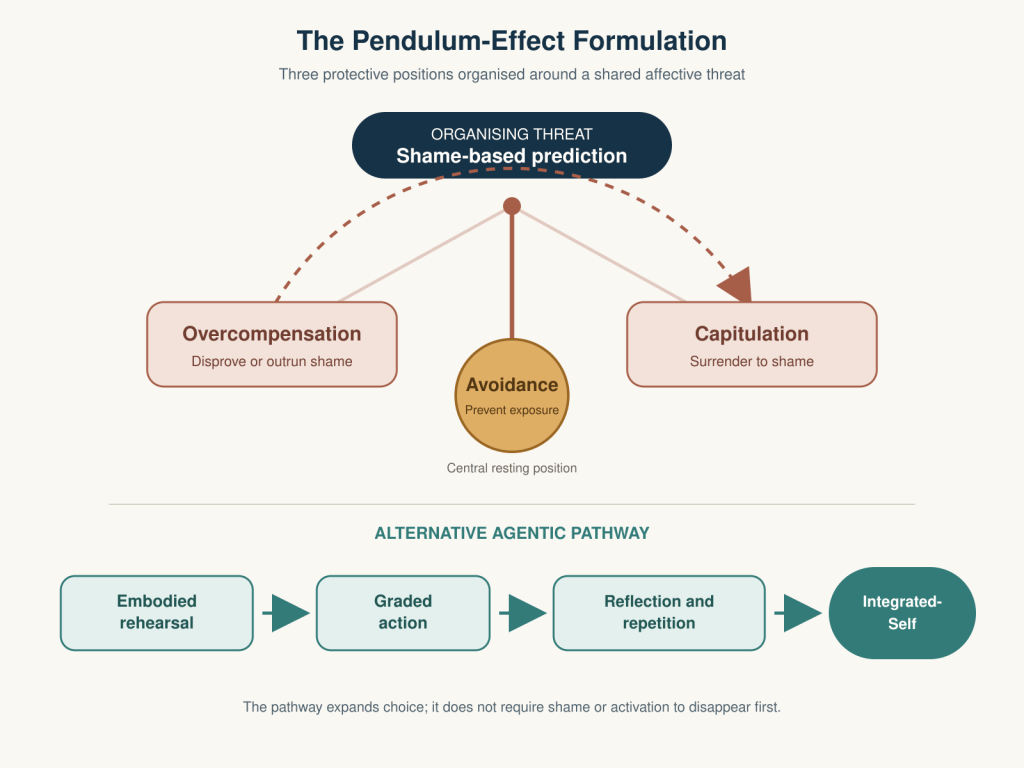
Figure 1. The Pendulum-Effect Formulation: Overcompensation, Avoidance and Capitulation represent different protective positions organised around a shared shame-based prediction. Embodied rehearsal, graded action, reflection and repetition provide an alternative agentic pathway through which a different response may gradually become available within the Integrated-Self.
In anticipation of shame, Anna moved towards Overcompensation: preparing excessively, mentally rehearsing every sentence and attempting to eliminate the possibility of error. When complete certainty remained unattainable, she shifted towards Avoidance: delaying her contribution, weakening what she wanted to say or remaining silent. After the meeting, she moved into Capitulation: attacking herself and treating her silence as proof that she was weak or incapable.
These apparently contradictory responses belonged to the same protective system. Overcompensation attempted to disprove the shame-based narrative. Avoidance prevented its anticipated exposure. Capitulation surrendered to it as though it were established fact. Each position offered some immediate regulation or certainty, but their repeated enactment maintained the shame-based understanding of the self.
The pendulum was expressed through the whole person. Overcompensation appeared as urgency, muscular tension, relentless preparation and vigilant monitoring of others. Avoidance appeared as restricted movement, a quieter voice, averted gaze and silence. Capitulation appeared as heaviness, reduced agency and repetitive self-attacking language. Thought, affect, attention, bodily organisation and behaviour reinforced one another.
Anna was not asked to argue her shame away or persuade herself that she was unquestionably competent. Instead, she was invited to test whether the internalised shame-based account represented the whole truth:
If the belief that I am inadequate were not allowed to make the entire decision, what would I do next?
If shame and self-doubt did not have the final say, what would I choose to do next?
These questions are consistent with Greenberger and Padesky’s use of acting as if, in which a person behaves experimentally in accordance with a more balanced alternative belief and observes the consequences (Greenberger and Padesky, 2016). Anna was not required to believe the alternative in advance; the action created an opportunity to gather information that her established shame-based belief and protective responses had previously restricted.
Asking one genuine question created a position that was neither overcompensating, avoidant nor capitulating. Anna participated without performing perfection. Her anxiety remained present, but it no longer determined the whole response.
In this application, acting as if did not require Anna to suppress her shame or convince herself that she was already confident, lovable or worthy. By enacting a valued response while shame remained active—and discovering that she could be visible, remain present and recover—Anna encountered embodied evidence that the shame-based prediction might not represent the whole truth about her. Through reflection and repetition, such experiences can gradually be incorporated into autobiographical identity and become increasingly available within the Integrated-Self.
The broader NA-CBT concept of the Integrated-Self has also been discussed in relation to NeuroAffective Narrative Reconsolidation, where experiences organised around threat and identity-disrupting meaning are revisited in the presence of regulation, agency and new autobiographical meaning (Mirea, 2026). The present article proposes a related, but not identical, process: embodied rehearsal may help the person discover that shame is an affective state accompanied by learned predictions, not an absolute description of identity.
The Pathway from Protective Pattern to Integrated-Self
The movement from a shame-organised protective pattern towards the Integrated-Self can be understood as an iterative sequence rather than a single technique. Although the stages are presented separately, therapy may move back and forth among them as experience generates new information.
1. Recognise the Pendulum movement
The Pendulum-Effect Formulation helps the person recognise how apparently different responses may be organised around the same affective threat. Attention is given not only to behaviour but also to affect, prediction, bodily organisation, attention and relational function.
The question shifts from What is wrong with me? to:
What is this response attempting to prevent, disprove or make certain?
For Anna, extensive preparation was not simply conscientiousness, silence was not simply passivity and self-attack was not simply low mood. Together, they formed a repeating attempt to manage anticipated shame. Overcompensation attempted to disprove inadequacy, avoidance prevented its anticipated exposure and capitulation treated the shame-based account as established fact.
2. Clarify an emerging value
Change requires more than moving away from anxiety or interrupting an unwanted behaviour. The person needs a direction in which they genuinely wish to move: participation, connection, curiosity, honesty, self-respect, courage or appropriate assertiveness.
A value should not become another idealised identity or perfectionistic standard. I want to relate with honesty is more workable than I must become a completely authentic person.
Anna’s emerging direction was participation. Her goal was not to appear impressive, eradicate anxiety or prove that she was competent. It was to contribute something genuine without abandoning herself. This direction provided a reason to act that did not depend upon feeling confident first.
3. Imagine the situation and its difficulties
Present-tense, multisensory imagery can evoke the anticipated situation before the person enters it (Hackmann, Bennett-Levy and Holmes, 2011; Holmes and Mathews, 2010). The image should include the Pendulum impulse, the values-consistent response, uncertain outcomes and recovery. Its purpose is to prepare for reality rather than script compulsory success.
Anna imagined entering the meeting, noticing people turning towards her and feeling the first signs of activation. She became aware of her lifted shoulders, tightened jaw, restricted breathing and urge to delay. She also noticed the familiar prediction: If I speak without complete certainty, I will expose my inadequacy.
The image was not changed into a fantasy in which Anna felt completely calm and everyone responded warmly. Instead, she imagined remaining activated while orienting towards the room, feeling the support of the chair and allowing a slower exhalation. She also imagined several possible outcomes, including interest, indifference, misunderstanding and disagreement.
Imagery made the shame-based prediction observable while creating a provisional model of how Anna might respond differently.
4. Embody and rehearse one observable response
The emerging value is translated into voice, movement, posture, attention and action. The person may rehearse a sentence, question, boundary, request, pause or other form of participation while noticing the protective impulses that arise.
Anna practised asking her question aloud. At first, her voice was quiet and apologetic. She surrounded the question with explanations intended to protect her from being wrong. Through rehearsal, she noticed these movements and experimented with saying the same words more simply.
The purpose was not to manufacture confidence or produce a flawless performance. It was to make participation behaviourally and bodily available. Regulation supported sufficient capacity for learning; it did not require Anna to become completely calm before speaking.
5. Enact it within the therapeutic relationship
Where relevant, the therapy relationship provides an immediate opportunity to practise honesty, disagreement, need, boundary or repair. The consulting room is not merely a protected place in which the person prepares for relationships elsewhere. It is itself a real relationship in which the Pendulum may become visible.
Anna noticed that she also tried to perform competence in therapy. She prepared detailed accounts, searched for the “right” insight and sometimes agreed with interpretations that did not entirely fit. She worried that disagreement would disappoint the therapist or make her appear resistant.
In imagery and rehearsal, Anna practised telling the therapist that a recent exercise had felt too structured and that she had felt less connected during it. She then expressed this in the session. She remained physiologically activated, but she did not overexplain, withdraw or surrender her experience.
The significance of this moment did not depend solely upon receiving reassurance. Anna discovered that she could express a difference and continue relating. The therapeutic relationship became a real site of embodied rehearsal, feedback and revision rather than another setting in which she had to perform correctly.
6. Test it in everyday life
Rehearsal becomes therapeutically meaningful when it is translated, where safe and appropriate, into graded action. The situation should matter enough to activate the existing prediction but remain sufficiently manageable to permit observation and recovery.
Anna’s first task was deliberately modest: to prepare one genuine question and ask it within the first ten minutes of a meeting. The task activated her fear of exposure without requiring her to dominate the discussion or deliver a flawless presentation.
When the moment arrived, Anna’s chest tightened and the familiar instruction returned: Wait until you are completely certain.
This time, she asked the question. Her anxiety remained present, but it no longer determined the whole response.
7. Reflect, adapt and repeat
The outcome is not classified simply as success or failure. The person compares what was predicted with what occurred, observes how activation changed and considers what supported presence and recovery. Difficult or ambiguous outcomes must be included rather than converted into a compulsory success narrative.
Anna’s question was answered and the meeting continued. She did not experience a sudden transformation, but neither did the humiliation she had predicted occur. Her body mobilised and then began to recover.
Anna had not proved that she would never be criticised. She had learned something more credible: she could speak without complete certainty, tolerate the activation and recover afterwards.
The response was subsequently adapted and tested in other situations. Anna expressed a preference about the direction of a project, declined an additional responsibility and practised contributing without producing an exhaustive defence. Repetition across varied contexts helped make the capacity more accessible without converting it into another rigid rule.
8. Consolidate authorship and expand authenticity
Reflection connects the action with a credible autobiographical understanding of the self. The person is invited to recognise:
A part of me anticipated shame, and I was also capable of acting according to what mattered.
Anna had not merely watched a rehearsed role ask the question. It was her body that tolerated the visibility, her voice that produced the words and her agency that remained present while doubt continued. Consolidating authorship allowed the experience to become part of her developing self-understanding without requiring her to claim permanent transformation.
Within this article, the Integrated-Self refers to an increasingly connected and flexible repertoire in which different affects, needs, values and action tendencies can be acknowledged without one protective position automatically controlling the whole response. Integration does not replace anxiety with permanent confidence or install a new idealised character. It expands what the person can recognise, tolerate, choose and enact.
Anna’s emerging understanding was therefore not:
I am always confident.
It was more credible:
I can notice the urge to prove, hide or surrender and still choose how I want to participate.
Why Action Can Precede Motivation and Confidence
People often wait not only for confidence but also for motivation. Yet motivation is not always a prerequisite for action; it can also be an outcome of action. Behavioural activation, exposure, skills rehearsal and behavioural experiments all make use of the principle that experience can generate information unavailable through reflection alone.
The mechanism is not repetition by itself. Repetition without awareness may consolidate an existing pattern. Useful rehearsal involves a meaningful prediction, tolerable activation, observable action, attention to the outcome, recovery and reflection. If the task overwhelms the person, it may reinforce the expectation that the situation is unmanageable. If it is effortless and emotionally irrelevant, little new learning may occur. Grading is therefore not a concession to weakness but part of the learning design.
Motivation may increase when the person experiences even a small degree of authorship: I did something that mattered while the old feeling was still present. This differs from waiting passively for an internal state to grant permission. It also differs from coercing action in the name of progress. The target must remain personally meaningful, collaboratively chosen and open to revision.
Bringing Embodied Rehearsal into Practice
In practice, embodied rehearsal is developed collaboratively around a personally meaningful and observable response. The therapist and client anticipate how the protective pattern may appear, rehearse the response while allowing manageable activation to remain present and, where appropriate, test it through graded action in everyday life. What was predicted is then compared with what occurred, including how the person responded, recovered and understood their own agency. The process is adapted and repeated across contexts, not to perfect a new performance, but to help a previously inhibited response become increasingly available within the Integrated-Self.
When ‘Acting as If’ Becomes Harmful
Embodied rehearsal is not universally helpful. It becomes clinically problematic when it asks a person to deny reality, conceal distress or perform beyond their capacity. Several distinctions are essential:
- Rehearsal versus masking: rehearsal expands choice; masking demands a socially acceptable performance while hiding need, fatigue or neurodivergent difference.
- Courage versus flooding: graded action permits activation and recovery; flooding overwhelms regulation and may reinforce danger.
- Aspiration versus deception: practising a skill differs from claiming competence, qualifications or safety that do not exist.
- Embodiment versus emotional invalidation: posture, breathing or voice work should not be used to tell a distressed person that their feelings are incorrect.
- Agency versus coercion: the person chooses the target action and retains permission to pause, modify or stop.
Trauma survivors may have extensive experience of performing compliance while internally mobilised, frozen or dissociated. Inviting further performance without attending to consent, relational safety and bodily cues risks repeating the problem. Regulation is not merely a preliminary exercise before the ‘real’ intervention; it is part of the conditions under which action can remain chosen and learnable.
A Necessary Scientific Caution
The language of neuroplasticity is sometimes used as though naming it proves a specific intervention. Neuroplasticity is a general property of the nervous system, not evidence that every repeated performance produces therapeutic change. Claims about neurological ‘encoding’ require precision: which process was measured, in which population, under what conditions and with what durability?
Performed and lived experiences may overlap in perceptual, motor and affective processes, but they are not interchangeable. Context, consequences, relationships, agency and autobiographical meaning matter. Theatre, psychodrama and role rehearsal may offer bridges to new experience; real-world generalisation still requires testing, reflection and consolidation.
Moreno’s work provides an important clinical and historical foundation for embodied rehearsal, while contemporary research on embodied and grounded cognition offers a partially compatible scientific context. The traditions can be brought into productive dialogue, but Morenian concepts should not retrospectively be presented as neuroscientific discoveries. Their relationship is one of conceptual convergence and clinical compatibility, not proof that contemporary neuroscience has directly validated Morenian theory or NA-CBT.
NA-CBT therefore uses neuroscience to constrain and enrich formulation, not to decorate it. Where evidence is indirect, the language should remain conceptual and provisional.
Rehearse—Do Not Pretend
‘Fake it till you make it’ becomes clinically useful only when pretence is replaced by carefully formulated rehearsal. People do not need to counterfeit confidence or suppress authentic distress. They can practise behaviours that express an emerging value while acknowledging the body’s protective response.
The Pendulum-Effect Formulation helps identify how overcompensation, avoidance and capitulation restrict action around a shared affective threat. Embodied rehearsal then gives the person a protected opportunity to use their own voice and body differently. Graded action carries the experiment into lived experience; reflection, recovery and repetition help establish whether the response can become more available across contexts.
Anna did not become somebody else. She did not eliminate uncertainty or install a permanently confident identity. She discovered that the anxious, self-protective part of her did not have to make every decision. Speaking became less foreign, recovery became more familiar and participation became a credible part of what she could do.
From an NA-CBT perspective, the therapeutic question is therefore not, ‘How can I convincingly pretend to be someone else?’ It is:
What response needs to be practised so that it can become more available within my Integrated-Self?
References
Barsalou, L.W. (2008) ‘Grounded cognition’, Annual Review of Psychology, 59, pp. 617–645. https://doi.org/10.1146/annurev.psych.59.103006.093639
Berghs, M., Prick, A.J.C., Vissers, C. and van Hooren, S. (2022) ‘Drama therapy for children and adolescents with psychosocial problems: a systematic review on effects, means, therapeutic attitude, and supposed mechanisms of change’, Children, 9(9), 1358. https://doi.org/10.3390/children9091358
Coles, N.A., Larsen, J.T. and Lench, H.C. (2019) ‘A meta-analysis of the facial feedback literature: effects of facial feedback on emotional experience are small and variable’, Psychological Bulletin, 145(6), pp. 610–651. https://doi.org/10.1037/bul0000194
Coles, N.A. et al. (2022) ‘A multi-lab test of the facial feedback hypothesis by the Many Smiles Collaboration’, Nature Human Behaviour, 6, pp. 1731–1742. https://doi.org/10.1038/s41562-022-01458-9
Cruz, A., Sales, C.M.D., Alves, P. and Moita, G. (2018) ‘The core techniques of Morenian psychodrama: a systematic review of the literature’, Frontiers in Psychology, 9, 1263. https://doi.org/10.3389/fpsyg.2018.01263
Greenberger, D. and Padesky, C.A. (2016) Mind Over Mood: Change How You Feel by Changing the Way You Think. 2nd edn. New York: Guilford Press.
Hackmann, A., Bennett-Levy, J. and Holmes, E.A. (2011) Oxford Guide to Imagery in Cognitive Therapy. Oxford: Oxford University Press. https://doi.org/10.1093/med:psych/9780199234028.001.0001
Holmes, E.A. and Mathews, A. (2010) ‘Mental imagery in emotion and emotional disorders’, Clinical Psychology Review, 30(3), pp. 349–362. https://doi.org/10.1016/j.cpr.2010.01.001
Jiang, L., Alizadeh, F. and Cui, W. (2023) ‘Effectiveness of drama-based intervention in improving mental health and well-being: a systematic review and meta-analysis during the COVID-19 pandemic and post-pandemic period’, Healthcare, 11(6), 839. https://doi.org/10.3390/healthcare11060839
Mirea, D. (2026) ‘NeuroAffective Narrative Reconsolidation: Integrating Traumatic Memories and the Development of the Integrated-Self in NeuroAffective-CBT’, NeuroAffective-CBT Online Journal, 5 March. Available at: article webpage (Accessed: 3 September 2026)
Moreno, J.L. (1946) Psychodrama: First Volume. Beacon, NY: Beacon House.
Moreno, J.L. (1947) The Theatre of Spontaneity. Beacon, NY: Beacon House.
Moreno, J.L. (1955) ‘Theory of spontaneity-creativity’, Sociometry, 18(4), pp. 105–118. https://doi.org/10.2307/2785848
Moreno, J.L. (1961) ‘The role concept: a bridge between psychiatry and sociology’, American Journal of Psychiatry, 118(6), pp. 518–523.
Moreno, J.L. (1965) ‘Therapeutic vehicles and the concept of surplus reality’, Group Psychotherapy, 18, pp. 211–216. https://doi.org/10.12926/ek7xhv15
Niedenthal, P.M. (2007) ‘Embodying emotion’, Science, 316(5827), pp. 1002–1005. https://doi.org/10.1126/science.1136930
Salter, A. (1949) Conditioned Reflex Therapy. New York: Creative Age Press.
Vygotsky, L.S. (1999) ‘On the problem of the psychology of the actor’s creative work’, in Rieber, R.W. (ed.) The Collected Works of L. S. Vygotsky, Volume 6: Scientific Legacy. New York: Kluwer Academic/Plenum, pp. 237–244. (Original work published 1932.)
Author’s Note
This article presents a conceptual NeuroAffective-CBT formulation intended for professional discussion and psychoeducation. It does not claim that embodied rehearsal is a stand-alone treatment or that the mechanisms proposed here have been uniquely validated for NA-CBT. Interventions should be adapted to individual formulation, consent, clinical risk and professional scope of practice.
Continue reading: Developing Authenticity Through Values-Guided Behavioural Experiments explores the next stage of Anna’s clinical illustration—from embodied possibility towards values, authorship and authentic living.


