

and How ‘TED’ can Help You Rewire It…
Why do some foods feel irresistible, while others barely tempt you? It is tempting to think cravings are just about taste, sweet, salty, sour, bitter, but the truth runs much deeper. Your brain and gut are in constant conversation, sending signals that shape not only what you like to eat, but what you want to eat again and again. But here’s the twist: those preferences aren’t fixed! With the right strategies, you can actually retrain your brain to crave healthier foods. One of the most practical tools for doing this is ‘TED‘ short for Tired, Exercise, Diet. Within the NeuroAffective-CBT approach, TED is one of the most compelling self-regulation frameworks. It uses the idea of an ‘imaginal friend‘, a life-coach or inner guide that can help you stay focused on daily choices which support meaningful lifestyle changes. These changes strengthen both physical health and immunity while also building psychological resilience, self-appreciation, and self-love.
Each component of TED – Tiredness (sleep), Exercise, and Diet, has strong empirical links to emotional and cognitive wellbeing. First introduced to the psychotherapy world nearly 20 years ago by behaviourist Daniel Mirea (Mirea, 2023), TED has become a cornerstone of the NA-CBT approach. At its core, TED highlights the Body–Brain–Affect triangle, showing how rest, movement, and nutrition work together to regulate cravings, balance mood, and improve overall health.
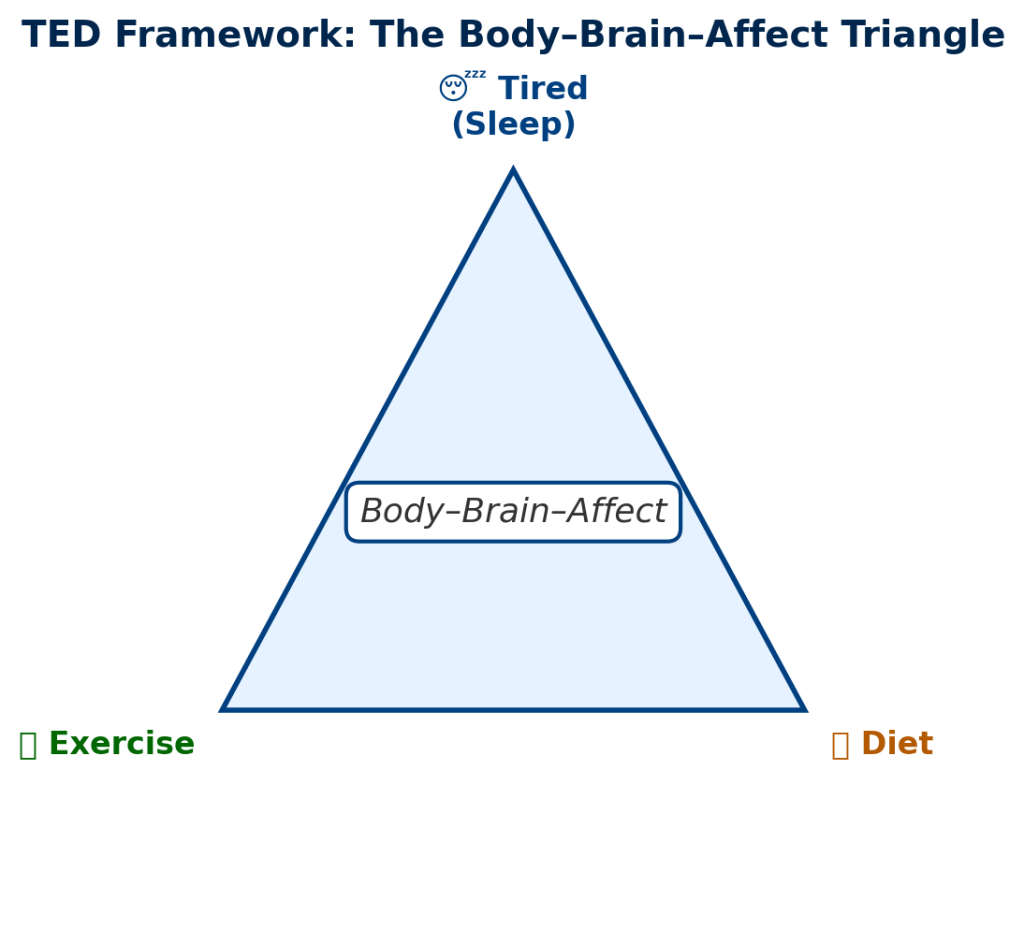
So, let’s think of TED as your inner coach and personal trainer, totally on your side but tough and fair, a voice you can hear all the time:
- Tired → how well you rest shapes hunger, hormones, and food choices.
- Exercise → physical activity resets dopamine and balances stress.
- Diet → what you eat trains your gut and brain to prefer certain foods.
And now… with TED in mind, let’s examine how cravings really work and how to rewire them.
The Three Layers of Food Preference
Scientists generally point to three systems that explain why we like certain foods:
1. Taste Buds (Diet in Action)
The tongue is the first gatekeeper of food preference. It detects sweet, salty, sour, bitter and, umami (savory, meaty flavour), behaviourally guiding us toward energy-rich or protein-rich foods. This happens because specialised neurons on the tongue can detect sweetness, saltiness, sourness, bitterness, and umami. They give us that instant “yum” or “yuck”. But taste alone isn’t the full story. What you repeatedly eat conditions your taste buds. A diet heavy in ultra-processed foods can dull sensitivity to natural flavors, while a shift to whole foods can make simple tastes more rewarding within 7–14 days (Wise, P. et al., 2016; Turner S et al., 2022).
👉 What does TED say? This is where D for Diet comes in: by choosing nourishing foods consistently, you retrain both your taste buds and your reward circuits. But also, E for Exercise: by changing habits and replacing eating with exercise rewiring occurs even faster and the brain is much more likely to ‘demand and accept’ protein-based products useful for muscle development.
2. Gut–Brain Signaling (The Sleep & Diet Link)
As food travels down the digestive tract, neurons detect its texture, temperature, and nutrients. Specialised “neuropod cells” are tuned to sense amino acids, sugars, and fats. These cells send electrical signals through the nodose ganglion straight into the brain, triggering dopamine, the neurotransmitter of motivation and reward Bohórquez et al., 2015. In other words, when sugar, fat, or amino acids hit the gut, they trigger dopamine release, shaping cravings at a subconscious level.
And here’s the worse news: poor sleep (The T from TED – Tired) makes these signals even stronger. Lack of rest ramps up ghrelin (the hunger hormone) and dampens leptin (the satiety hormone), pushing you toward high-calorie foods. At the same time, a diet rich in fiber, protein, and complex carbs strengthens gut–brain communication in healthier ways.
👉 TED takeaway: better sleep and diet quality work hand in hand to keep cravings in check.
3. Learned Associations (Exercise as a Reset Button)
The brain is able to link the flavour of food with its aftereffects, like blood sugar rise and dopamine rise after a sweet snack. Over time, these associations become powerful drivers of preference de Araujo et al., 2008.
As such, our brain learns fast to link specific flavours with specific metabolic outcomes. As in the earlier example, sweet taste plus a rise in blood glucose teaches the brain to crave sugar.
And even though artificial sweeteners and many fruits contain little or no glucose, when paired with high-carbohydrate foods (e.g., low-sugar jam with a croissant or fruit with cornflakes), the brain links their sweet taste to the subsequent glucose surge. Over time, this conditioning strengthens the craving pathway at both behavioural and neural levels.
However, regular and intensive Exercise (The E out of TED) helps break this loop. Movement not only burns energy but also improves insulin sensitivity and modulates dopamine pathways, making it easier to “reset” reward associations. People who exercise regularly often find it easier to shift away from addictive food patterns.
👉 TED takeaway: put together, these systems explain why food isn’t just fuel. It’s a constant feedback loop, where your body teaches your brain what to want. You can use movement to retrain your brain’s learned food-reward pathways.
Your Gut Is Training You
We tend to think of the gut as just a digestion machine. But in reality, it’s a sensory system. As food moves through the stomach and intestines, neurons are watching closely. They respond to stretch (how full your gut is), texture, spiciness, and even temperature.
The most fascinating players are those neuropod cells. They act like food sensors, tuned to the chemistry of whatever you eat. The moment they detect sugars, fats, or amino acids, they send electrical signals to the brain in milliseconds Kaelberer et al., 2018. The brain responds by releasing dopamine, making you feel motivated to seek out more of that food.
This whole process is subconscious. You don’t “decide” that chocolate cake is rewarding. Your gut tells your brain before you even realize it.
Sweetness and the Dopamine Trap
Sweet taste gives us the clearest example of how these systems interact. Humans are naturally wired to like sweet things — especially children. Sweetness signals calories, which the brain rewards with dopamine.
So what about artificial sweeteners? Why are those still problematic? As explained earlier, sugar reliably increases blood glucose and dopamine. Non-caloric sweeteners taste sweet but don’t raise blood glucose. And at first, dopamine doesn’t budge. But here is the twist: with repeated exposure, artificial sweeteners do start to trigger dopamine. Why? Because your brain learns to expect that sweet taste to mean “energy incoming” Tellez et al., 2016.
And as already mentioned things get even more complicated when you pair diet drinks (sweet but calorie-free) with a burger and fries (calorie-dense). Over time, your brain begins to link the sweet taste with a metabolic effect. Later, even diet fizzy drink alone can change your insulin response, as if it contained sugar Swithers, 2013.
👉 A practical tip from TED? If you enjoy a diet or low-calorie drink, it is probably better to drink it separately from high-carb meals. Otherwise, you may condition your body to release insulin in ways that throw off blood sugar control. But of course, it would be ideal to avoid sugar or sweetener rich drinks all together especially if your meal is equally rich in carbs and instead… simply replace it with water!
The Psychology of Belief
It’s not just biology at play. Your mindset about food can literally change how your body reacts. Stanford University professor Alia Crum ran a striking study: participants were given the exact same milkshake but told two different stories about it. Some were told it was “indulgent, high-calorie, rich and satisfying.” Others were told it was “light, low-calorie, and healthy”. The results? The “indulgent” shake produced bigger rises in insulin, ghrelin (a hunger hormone), and blood glucose. People also reported feeling more satisfied Crum et al., 2011. The same drink or shake but a totally different body response, based only on belief.
This is not the classic placebo effect. It is a belief effect: our expectations about food shape our physiology!
Rewiring Your Cravings
Here’s the good news: your food preferences aren’t set in stone. Scientists describe them as soft-wired, flexible and open to change. Studies show that if you consistently eat a food for 7–14 days, especially when paired with enjoyable or energizing foods, your brain starts to assign more value to it. Translation: it literally tastes better over time (Wise, P. et al., 2016; Turner S et al., 2022; Small et al., 2019).
This is why people in different dietary war-camps like keto, vegan, Mediterranean, etc. Often feel so passionate about their way of eating and fight each other in research facts. Their brains have been conditioned to find their chosen foods the most rewarding.
And you can use the same principle to your advantage. Want to enjoy more leafy greens? Pair them with foods that give you a metabolic boost. Over time, your brain will start rewarding you for those choices.
The Bigger Picture
At the deepest level, your brain isn’t chasing sweetness, salt, or even dopamine. What it really wants is energy for neurons. Food preference is just the surface expression of this survival mechanism.
The catch? In today’s food environment, ultra-processed and hyper-palatable foods hijack this system. They deliver intense dopamine spikes that make ordinary, healthier foods seem bland by comparison Johnson & Kenny, 2010.
But the opposite is also true: by gradually shifting your diet toward whole, nutrient-rich foods, your dopamine system adapts, and those foods become genuinely more rewarding.
Final Thoughts
Food is far more than fuel. It’s a dialogue between taste buds, gut neurons, brain chemistry, and even your beliefs. Together, these systems decide what you crave, what satisfies you, and what you keep reaching for.
Perhaps a useful analogy would be to view food preferences as being both hard-wired and soft-wired. Hard-wired circuits push us toward energy-rich foods. Soft-wired associations, however, can be reshaped through repeated exposure and lifestyle choices. And this is where TED truly shines:
- Tired → Sleep enough to regulate hunger and strengthen decision-making.
- Exercise → Move daily to reset dopamine and insulin sensitivity.
- Diet → Feed your gut and brain with nutrient-rich foods that train cravings. Add products like vinegar, lemon, kefir to your diet in order to keep the glucose spike down.
Modern processed foods hijack dopamine pathways, but TED offers a counterweight. With small, consistent shifts, better rest, regular movement, and smarter eating, you can rewire your cravings and restore balance. In a well-known study, participants drank the same milkshake but were told it was either “indulgent” or “low-calorie”. The indulgent version triggered stronger hormonal and metabolic responses, showing that belief changes physiology – so the mindset matters.
This is where TED would demand from you a renewed and improved attitude and mindset:
Diet: Choosing whole foods builds a narrative of self-care that strengthens psychological reward.
Tired: A good sleep and regular rest bites improve emotional regulation, making you less vulnerable to comfort eating and in general emotions are more manageable due to a less reactive amygdala.
Exercise: This list is very long – builds muscle, burns fat, deals with insuline resistance and overall boosts confidence and reinforces positive self-beliefs about health.
✨ In short: TED isn’t just a checklist; it is a neuroscience-backed guide for aligning your lifestyle with the way your brain and gut actually work. By honoring the ‘big three‘, sleep, exercise, and diet, you can gradually teach your brain to want specific activities and foods that fuel health and wellbeing.
Recommended Reading
If you’d like to explore the science behind food preference and reward systems in more depth, here are a few excellent resources:
- Tired, Exercise and Diet your way out of trouble, TED is your best friend ! by Mirea D., 2023.
- Rethinking Food Reward – Small, Schachter & DiFeliceantonio (2019). A comprehensive review on how food interacts with the brain’s reward circuits.
- Gut-brain sensory transduction – Bohórquez et al. (2015). Seminal paper on neuropod cells and how your gut communicates directly with your brain.
- Mind over milkshakes – Crum et al. (2011). Classic psychology study showing how belief about food changes the body’s physiological response.
- Artificial sweeteners induce metabolic derangements – Swithers (2013). Review on how repeated exposure to sweeteners influences metabolism and brain reward systems.
- For a deeper dive into food habits, check out Dana Small and colleagues’ excellent review: Rethinking Food Reward (Annual Review of Psychology, 2019).
- Wise, P.-M., Nattress, L., Flammer, L. J., & Beauchamp, G. K. (2016). Reduced dietary intake of simple sugars alters perceived sweet taste intensity but not perceived pleasantness. American Journal of Clinical Nutrition, 103(1), 50–60. https://doi.org/10.3945/ajcn.115.112300PubMed
- Turner, S., Diako, C., Kruger, R., Wong, M., Wood, W., Rutherfurd-Markwick, K., Stice, E., & Ali, A. (2022). The effect of a 14-day Gymnema sylvestre intervention to reduce sugar cravings in adults. Nutrients, 14(24), 5287. https://doi.org/10.3390/nu14245287ResearchGate

 neuroaffectivecbt.com