

Daniel Mirea (6.01.2025)
Are you predisposed to self-doubt, low self-esteem, even long episodes of negative self-talk following perceived judgement or criticism in an ordinary discussion with your partner or in any other social situation? Are you highly sensitive to your partner’s opinions about you, even if not always entirely negative…? Do you often experience an intense emotional reaction in response to perceived criticism or rejection? Do you tend to put a negative spin on all positive feedback received from your partner (i.e., “Yes… But..”). Do you ever experience overwhelming anxiety or fear in anticipation of situations where a judgment or evaluation might occur? Have you noticed that your emotional responses to rejection or criticism are disproportionate to most situations? And last but not least, have you also been diagnosed with ADHD? And if not, do you normally struggle with poor focus, poor concentration, impulsivity or attention deficit in general?
If the answer to the above questions is overwhelmingly ‘Yes’, then it is important to first of all know, that you are far from being alone. It is crucial to recognise that feelings of rejection are universal and not something to be ashamed of; feeling rejected is a human experience that transcends age, gender, and background. And secondly, according to some of the relating research, you might indeed be struggling with a condition known as Rejection Sensitive Dysphoria (or RSD on short) which, experts like Dr William Dodson would suggest is part of the ADHD spectrum. According to the NHS, adults with ADHD (Attention-Deficit/Hyperactivity Disorder) may find they have problems with keeping things organised, time management, following instructions and focusing on completing tasks, coping with stress, feeling restless or impatient, impulsiveness and risk taking. Due to impulsivity, difficulty following through, and a tendency to become distracted, adults with ADHD may experience challenges in relationships. They might forget important events, struggle to listen attentively, or have difficulty managing emotions, all of which can strain connections with others. The emotional aspects of ADHD, such as heightened sensitivity to criticism or rejection, would also contribute to interpersonal issues. Individuals may react strongly to perceived rejection or disapproval, leading to emotional outbursts or withdrawal.
Diagnosing ADHD is not as straight forward as it seems, not in the current clinical environment where ADHD specialists are few and far between in the UK and an assessment takes a significantly longer time to investigate. ADHD symptoms tend to be noticed at an earlier stage in life and are usually first pointed out by teachers during primary or even secondary school years. Some of the fortunate cases are diagnosed when children are under 12 years old and therefore would receive tailored support (medication + CBT via NHS) but much too often, ADHD would be diagnosed later in life. The assessment process is longer than usual, and ideally ought to include parental bio-psycho-social data which is not always available.
The increasing digitalisation of young adolescents’ lives presents yet another significant challenge when diagnosing ADHD. The growing integration of digital devices, social media, and online platforms into daily routines can have several effects on a young person’s bio-psycho-social development, potentially complicating the diagnostic process. The shift towards technology isn’t limited to entertainment; it’s pervasive in educational platforms, daily tasks, fitness routines, shopping, and even health services. These digital engagements place an enormous strain on the brain, particularly in adolescents whose brains are still developing, a process that continues until around the age of 24. Given the brain’s plasticity at this stage, it’s crucial to consider the impact of screen addiction, as it may lead to behavioural patterns that clash with real-world social interactions and cognitive demands. One of the core issues is that digital platforms provide instantaneous gratification, whether through swiping, liking, or receiving immediate feedback. This creates a mismatch with real-life interactions, where responses aren’t immediate, and social cues and conversations require patience and focus. In face-to-face interactions, we can’t hit “pause” or “swipe left” when we lose interest.
Young ambitious adults proudly advertise on their LinkedIn profiles, ‘I am an excellent multi-tasker and a doer’, without fully understanding the consequences. And of course, prospectives employers love it, thus rewarding it and reinforcing it even more. Nonetheless, research is pointing in a completely different direction. It is evident that hours of daily use, would lead to an increased reliance on screens to meet our basic needs and over years, this could lead to an attention deficit, lack of impulse control, poor attention-orientation or in other words, irritability, impatience, poor concentration and of course, lack of interpersonal skills. All these are symptoms replicated on the ADHD spectrum and by default Rejection Dysphoria.
The digital world offers a form of cognitive and behavioural convenience, where tasks are often broken into smaller, easily digestible chunks. However, this constant stimulation requires significant mental energy, leading to faster depletion of resources like glucose, which in itself supports the neurobiological addiction to technology. Over time, this may contribute to longer-term health issues such as pre-diabetes, a condition that has been increasingly observed in younger populations, especially those who rely heavily on digital devices (Mirea, 2024). Thus, it is essential to recognise how the digital world reshapes adolescents’ brains often with resulting emotions and behaviours reminding of an ADHD condition.
Whether the digitalisation of our lives is changing the human brain to the point that an ADHD personality will be the new norm, and the actual diagnosis will be dropped one day, remains speculative. For now, this suggestion should be viewed more like the domain of a conspiracy theory and as such, we must direct attention to the current empirical evidence and facts we know and understand. There is indeed a notable increase in the ADHD population with a prevalence of up to 5% among both the young and adult population. There is also a questionable trend among the secondary schools’ population in the UK, to request an ADHD investigation. It is equally evident that individuals that struggle with ADHD symptoms have significant interpersonal problems1 and therefore would fit the criteria for Rejection Dysphoria.
Rejection dysphoria could be summarised as a condition characterised by extreme emotional pain or discomfort in response to perceived or actual rejection, criticism, or failure. It is commonly associated with ADHD, where individuals may experience heightened sensitivity to negative feedback. However, although the data is lacking at the moment and, clinical experience shows that RSD symptoms can be common outside of the ADHD spectrum as well. Rejection dysphoria can lead to intense feelings of inadequacy, anxiety, and low self-esteem, and may cause individuals to avoid situations where they fear rejection.
Effective NeuroAffective-CBT strategies for Rejection Dysphoria
Psychoeducation
Understanding rejection dysphoria and its maintenance formula2 is an important first step. When we encounter rejection, our mind often produces a surge of unpleasant thoughts, reels and narratives that lead to intensive rumination3, self-criticism and self-blame. This creates significant psychological pain, sadness and fear. And in fact, these latter emotions are often the reason why clients come to therapy in the first place, so psychotherapists often investigate the emotional experience presented rather than the rejection dysphoria underlying it all.
The complex maintenance cycle for RSD can be explained via a relatively simple formula:
- phase 1: Activating Situation
- phase 2: I am not good enough/ Nobody wants Me
- phase 3: Fear of Rejection
- phase 4: Hyperarousal
- phase 5: Avoidance
- phase 6: Self-Criticism (resulting from avoidant behaviour)
- phase 7: Sadness
- phase 8: The maintenance cycle is closed off with an escalation of sadness, self-blame and self-criticism which confirms the original deeply-rooted6 belief (phase 2) and the dominant fear of rejection (phase 3). It is important to mention that the maintenance program is not always linear (or circular), and sometimes avoidant behaviour (phase 5), can instantly create a feedback loop by reinforcing the ‘Not Good Enough-Nobody Wants Me’ deeply-rooted belief.
This formula can enable the individual to identify triggering situations that would easily activate this maintenance cycle. It facilitates a ‘pause’, taking a moment, to breathe and observe one’s thoughts and feelings from a safe distance, without judgment. This is a good opportunity to engage in a more realistic and compassionate Self-to-Self dialogue between the Wise Mind and the Anxious Mind for example, ‘…here we go again… here comes my rejection script into play…’. This is often an empowering process that helps individuals understand the difference between a construct of the mind and a narrative or a script created as a maintenance program that favours the rejection dysphoria, rather than the actual reality.
Writing therapy – Journaling
Thinking should not necessarily lead to believing and impulsive acting !
CBT provides a useful framework for understanding the relationship between (triggering) situations, thoughts, emotions, and behaviours. By engaging in journaling, individuals can break down their experiences and assess them more objectively, especially when faced with challenging emotions such as those triggered by fear of rejection. Here’s how the process could work, using the example of rejection:
- Triggering Situation: The first step is to identify and write down the situation that triggered the emotion. For example, “I was not invited to my friend’s gathering.“
- Automatic Thoughts and Images: This involves noting down the initial thoughts and mental images that arise in response to the triggering event. For example, “I must have done something wrong,” or “They don’t care about me anymore.” These thoughts are often automatic and not necessarily grounded in fact.
- Emotions and Intensity: Next, it’s helpful to note the emotions experienced and their intensity. Using a scale from 0 to 100, one might rate how intensely they feel emotions like sadness, anger, or anxiety. For instance, “I feel 80% sad and 50% angry.“
- Evidence for and Against the Thought: This is where CBT helps distinguish between thoughts and beliefs. By writing down evidence for and against the automatic thought (e.g., “I must have done something wrong“), a person can begin to evaluate whether the thought is realistic or based on assumptions. For example:
- Evidence for: “I haven’t been in touch with my friend much recently.“
- Evidence against: “I haven’t done anything to upset them. They might have simply forgotten.“
- Reevaluation and Perspective: The goal is to challenge unrealistic thinking. This process involves considering alternative explanations and recognising that not all thoughts are facts. For instance, “Not being invited doesn’t mean they don’t care about me,” or “People forget things sometimes.“
- Behavioural Response: The final step involves considering how the individual might behave differently if they fully accepted the more balanced thought. Perhaps instead of withdrawing or acting out of anger, they might reach out to the friend to express their feelings or simply move forward without assuming the worst.
The above process helps individuals become more aware of the patterns of their thinking, the validity of their assumptions, and the impact those thoughts have on their emotions and behaviours. Through journaling and reflection, they can foster greater emotional resilience, clearer thinking, and healthier responses to perceived rejection or other challenging situations (Rude S. et al., 2011)5 .
Compassionate-Acceptance
..and.. Commitment to New Actions !
Compassionate-acceptance can also help navigate feelings of rejection more effectively, by dealing directly with the inevitable avoidance (phase 5). Avoidance is natural, when we fear something we tend to stay away. But in the case of fear of rejection, avoidance is a lot more subtle, for example not speaking out about the feelings experienced inside, procrastinating, putting things off, etc. Understanding the maintenance formula helps identifying such maladaptive avoidant strategies. Accepting without judgement that avoidance ‘feels right’ at times (i.e., it is understandable that I should feel like this..) but also accepting the need for a new direction – a committed action.
For example.. Avoidance (name the type of avoidance – “procrastination“) feels right in the moment but it is not always the best course of action in the long run, since it does not lead to creative, healthier or more adaptive alternatives, just as my formula suggest…. besides, I made a commitment to change and implement… (name the new coping strategy – “I am a go-getter and a doer, what’s the worst that can happen“).
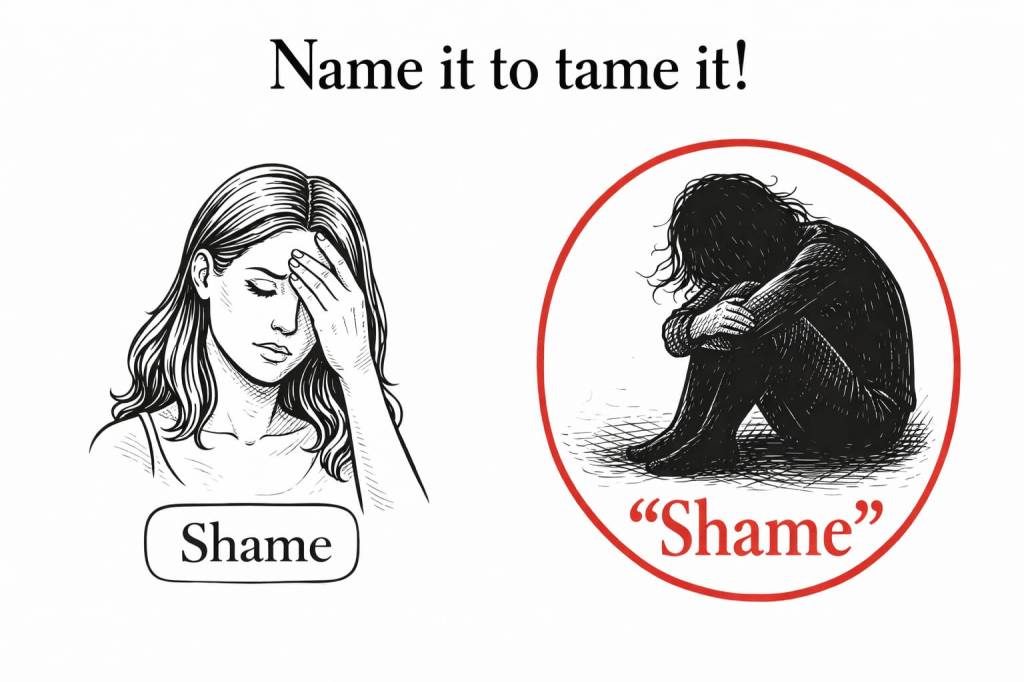
Compassionate-acceptance can be a challenging practice, especially during moments of emotional distress, rejection, or pain. The key to cultivating self-compassion is to recognise that emotions means being alive, part of the human experience, and that it’s okay to feel difficult emotions without trying to immediately change them or suppress them. This accepting self-talk is foundational to healing and inner resilience. Using self-kindness or compassionate statements that resonate would help the process e.g., ‘this is a difficult moment; this is a painful experience; I hurt because I actually do care… Mistakes are part of being human, they do not need define me‘.
Self-regulation methods for dearousal
What goes up, must come down…
An interesting tool recommended by NeuroAffective-CBT is Pausing and Observing – pausing with the curiosity of a scientist or even that a child, observing and labelling an unpleasant emotion experienced, rather than allowing it to worry you. Note the intensity of an emotion from 0-10 and once again, take a curious interest in the fact that the emotion experienced is not always felt as an extreme or an all-or-nothing phenomenon instead, it has different levels of intensity. Finally, locating it within the body allows for an isolation of the problem and an intentional reduction to its psychosomatic dimension. For example, a tightness in the chest muscle on a level of ‘5’ sounds a lot better than – this thought must be true because it hurts so bad inside. This would enable the next step which is the progressive relaxation of the muscular distress identified in that region. Rejection sensitivity and anxiety in general, triggers a stress response in our bodies, known as the fight-flight or the threat system. This involves a range of physiological responses including muscle tightness and muscular contractions.
Engaging in emotional regulation techniques such as progressive muscle relaxation (or PMR), abdominal breathing, body scanning or comprehensive-distancing, can help gradually turn the threat system off which eventually leads to dearousal – the process that turns off the fight-flight system.
It is easier to achieve emotional-distancing from a position of ‘calm’. Comprehensive-Distancing in NeuroAffective-CBT involves looking at the experience of rejection, rather than looking from, or through the lenses of rejection, almost as if one would look at a movie or an external script or a narrative unfolding before him or her, and accepting that, after all these are all normal products of a stressed mind. This external perspective can speed up the fading of negative emotions. Psychoeducation and understanding the basic maintenance formula helps with catching early the triggering narrative which prevents the activation of the whole maintenance cycle.
If comprehensive-distancing helps gain a fresh perspective and creates distance from negative thoughts and unpleasant emotions, Distraction Techniques are slightly different and it may involve watching a favourite show, physical exercise, walking, running, a cold shower, or any other activity leads to a reduction in the emotional intensity.
Abdominal Breathing or diaphragmatic breathing is arguably the most important component of the relaxation process. It can be used in parallel with PMR or as a tool on its own. When we experience rejection, our bodies may perceive it as a threat to our safety. Once again, deep breathing can also signal to the parasympathetic nervous system that you are safe. As a rule, when breathing abdominally the abdomen expands and slowly relaxes in perfect synch with the exhalation process which must be twice as long as the inhalation part. The whole breathing in–holding –breathing out, process could last up to 10-16 seconds, the longer the better.
- Find a Comfortable Position: Sit or lie down in a quiet place where you feel at ease.
- Inhale Deeply: Through your nose, inhale slowly for a count of about 4 seconds, allowing your abdomen to rise.
- Hold the Breath: Hold your breath for a count of about 2 to 4 seconds.
- Exhale Slowly: Breathe out through your mouth for a count of about 8 seconds, ensuring the exhalation is longer than the inhalation.
- Repeat: Continue this cycle for several minutes while focusing on the sensation of your breath and your body relaxing.
Abdominal breathing is not the easiest style of breathing to master, and it feels a little unnatural, sounding and feeling more like an unconscious ‘sigh’. In fact, for all intents and purposes, it could well be a deep long sigh. The act of sighing often involves a deep inhalation followed by a longer exhalation, which mirrors the principles of abdominal breathing. Sighing is part of the circadian rhythm6 of calming the body down and rejuvenating the blood with oxygen. When we sigh, we often take a deep breath in, followed by a slow, extended exhale. This act serves as a natural way to release tension in the body and helps reset our respiratory system. In fact, sighing can be thought of as the body’s way of re-establishing a balance in our breathing, particularly when stress or shallow breathing has been lingering. Both sighing and abdominal breathing activate the diaphragm more fully than regular chest breathing, promoting a greater exchange of oxygen and carbon dioxide, which helps calm the nervous system.
Progressive Muscle Relaxation (PMR)
PMR refers to a gradual tensing up and relaxation of all muscle groups in a specific order; starting with the head and facial muscles and working downward through all major muscle groups. Body Scanning is a similar procedure where muscles are relaxed only with a focused-attention but no previous tensing is necessary in this case. Visualising images that commonly induce a state of relaxation, the sun, a beach, a green field, trees etc., can add to the experience.
It can be equally useful to prepare a list of soothing activities or items in advance, for easier use during intense emotions. Engaging all five sensory modalities light-vision, taste, smell, sound and temperature can equally assist with attention-orientation and focus, grounding and feelings of safety. Being relaxed or in a state of ‘calm’ means feeling safe. It is important to understand cultural differences, personal values, and preferences and to identify what specifically soothes an individual; taking a warm bath or enjoying lavender scents might work for some but not for others. These are all attention-training and relaxation exercises commonly known as mindfulness exercises, PMR or grounding, all developed within the field of CBT with a clear purpose – to increase one’s ability to focus on sensations without fear or judgement, to learn to redirect attention as needed to regulate the autonomous nervous system and to eventually reduce the impact of rejection sensitivity.
PMR was first introduced as a behavioural treatment by Edmund Jacobson in 1929 and has proven to be one of the most effective interventions for stress management to date. Jacobson was able to prove the connection between excessive muscular tension and different disorders of body and mind. He found out that tension and exertion was always accompanied by a shortening of the muscular fibres, that the reduction of the muscular tonus decreased the activity of the central nervous system, that relaxation was the contrary of states of excitement and well suited as a general remedy and prevention against inflammatory and psychosomatic disorders.
Conclusion
Rejection dysphoria, whether a significant part of ADHD or a condition on its own, it tags along significant emotional pain which eventually dents our inner resilience. The prospect of navigating through life under the fear of constant rejection, goes against our very own survival instinct. The possibility of losing someone becomes somatically, extremely painful. Hence, it is such painful events and the emotions resulting from rejection, we are trying to avoid at all costs. And this is only natural to us since, as a mammal species, we are neither designed, nor would we ever evolve to a level, where surviving alone is a desirable option.
The answer almost always is, cultivating inner resilience. Confidence and acceptance are essential aspects of building emotional resilience and nurturing hope. Emotional resilience is not about avoiding emotional pain but instead it is about learning how to navigate through it with greater ease. By acknowledging the impact of rejection and adopting a curious stance towards new opportunities and excitement about the future possibilities, we develop acceptance and willingness to invite whatever may come along – if one door closes, another one opens!
Practicing self-compassion, and developing strategies for emotional regulation and self-acceptance, can work toward cultivating both confidence and emotional resilience. Confidence and emotional resilience are in fact, intertwined. Resilience is not just about bouncing back, but about learning, evolving, and embracing our emotions with kindness and acceptance.
As we continue to navigate life’s challenges and bounce back from setbacks, our confidence grows. Each experience of navigating emotional pain and emerging stronger, builds a foundation for the next challenge, reinforcing our sense of self-worth and ability to handle whatever comes our way. In essence, emotional resilience is a lifelong practice. It is ultimately, about embracing the full range of human emotions, staying open to new experiences, and treating ourselves with the same kindness and understanding that we would offer to others.
Foot Notes
1 Interpersonal problems, refers to difficulties and conflicts that arise in relationships between individuals. These issues can manifest in various forms, such as communication barriers, misunderstandings, disagreements, or emotional struggles. Interpersonal problems may occur in personal relationships, such as family and friendships, as well as in professional settings, including workplace dynamics. Common causes include differences in values, personalities, expectations, and communication styles. Addressing these problems typically involves improving communication, developing empathy, and finding common ground.
2 In CBT, the maintenance formulation refers to the concept that explains how certain thoughts, behaviours, and environmental factors contribute to the persistence of psychological problems. It typically includes the following components:
- Cognitive Factors: Negative thought patterns or cognitive distortions that individuals may hold about themselves, others, or their situation.
- Behavioural Factors: Specific behaviours that reinforce the problem, such as avoidance, substance use, or maladaptive coping strategies.
- Emotional Factors: Emotions that arise from cognitive and behavioural patterns, often contributing to distress.
- Environmental Factors: Contextual or situational elements that maintain or exacerbate the issue, such as social support or life stressors.
The maintenance formula helps therapists and clients understand how these elements interact to sustain a disorder, allowing for targeted interventions to break the cycle and promote positive change. By addressing each component, clients can develop healthier thought patterns, behaviours, and coping mechanisms.
3 Rumination, refers to intensive and counterproductive worry. The process of continuously thinking about the same problem, thoughts or feelings, often in a repetitive and counterproductive manner. It typically involves dwelling on negative experiences or distressing emotions rather than resolving them. Rumination can lead to an increase in anxiety, depression, and stress, as it focuses on past events and perceived failures, preventing constructive problem-solving. In a clinical context, it is often associated with various mental health disorders and can hinder recovery. Strategies to manage rumination include mindfulness practices, cognitive-behavioural techniques, and engaging in distracting or constructive activities.
4 Deeply-rooted beliefs (DRBs) have been described in detail by Mirea (2024) and refers to the lenses through which we see the world and ourselves. DRBs have been characterised in the psychotherapeutic literature as schemas by J Young or P Salkovskis. Dr Donald Meichenbaum suggests, DRBs are core organising principles, often sounding like a code of honour, which the individual cannot afford to break, the cost would be too high, and yet consciously unknown.
5 Rude S et al., 2011. Social Rejection: how best to think about it. This research supports the idea that expressing feelings and contemplating potential outcomes even after a rejection experience, can help individuals process their emotions more effectively. https://link.springer.com/article/10.1007/s10608-010-9296-0
6 Circadian rhythm is like a biological clock influenced by external cues, such as light and temperature, and plays a crucial role in determining sleep patterns, feeding behaviour, hormone release, and other bodily functions. https://www.sciencedirect.com/science/article/abs/pii/S1087079203900025

 neuroaffectivecbt.com